What Is Solana?
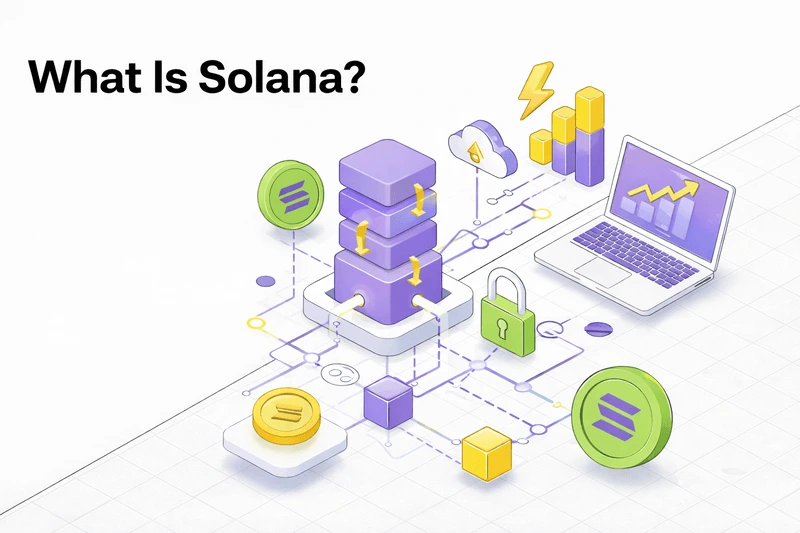
Solana is a high-performance blockchain designed for speed, low fees, and scalability. It allows users to send transactions quickly, interact with decentralized applications, and pay very small fees.
Solana is widely used for DeFi, staking, NFTs, and Web3 applications, largely because of its technical design and growing ecosystem. But what exactly is Solana, and why has it gained so much attention?
A Simple Explanation of Solana
At its core, Solana was built to solve one major problem:
How can a decentralized network stay fast and affordable even when usage grows dramatically?
Many blockchains slow down as demand increases. Transactions become more expensive, confirmations take longer, and users compete for limited block space.
Solana takes a different approach. Instead of relying on additional layers or separate execution systems, it focuses on optimizing the base layer. The result is a network designed to handle a high volume of activity while remaining accessible to everyday users.
If you want to understand the technical foundation behind this design, the next step is How Solana Works.
Why Solana Was Created
Before Solana, many blockchains faced similar limitations. Transaction speeds were slow, fees increased during congestion, scalability was limited, and user experience suffered.
Solana was designed to reduce these bottlenecks by rethinking how blockchains handle ordering, execution, and data propagation. A focused explanation of the performance side is covered in Why Solana Is Fast.
What Makes Solana Different
Solana stands out because of its architectural choices. One of the most important innovations is Proof of History, a cryptographic method that helps establish transaction ordering in a verifiable way.
This reduces overhead and supports higher throughput. You can learn more in Proof of History.
What Is SOL?
SOL is the native token of the Solana blockchain. It is used to pay transaction fees, participate in staking, and interact with applications on the network.
Anyone who uses Solana, whether for DeFi, NFTs, or games, will interact with SOL in some way. If you are new to staking, a good next step is What Is Staking.
How Solana Works at a High Level
When you send a transaction on Solana, it is signed, forwarded through the network, processed by validators, and confirmed quickly. Solana is designed to process many transactions efficiently, including parallel execution when transactions do not conflict.
A deeper explanation of this flow is covered in How Solana Works.
What Is Solana Used For?
Solana supports a wide range of applications.
In DeFi, it powers decentralized exchanges, lending platforms, and liquid staking protocols. In NFTs, it enables low-cost minting and frequent trading. In Web3, it supports wallets, games, dashboards, and financial tools that benefit from speed and low fees.
If you want to understand the mechanics behind staking and DeFi, see:
Is Solana Secure?
Solana uses Proof of Stake, cryptographic verification, and economic incentives to secure the network. Validators process transactions and participate in consensus, while delegators support them by staking SOL.
If you want to understand this relationship better, see:
Advantages and Tradeoffs of Solana
Solana offers fast transactions, low fees, and an active developer ecosystem. At the same time, a performance-focused design generally requires more capable validator hardware than some other networks.
This tradeoff supports real-world usage at scale, which is a core goal of Solana’s architecture.
Final Thoughts
Solana is more than just another blockchain. It is a platform built for speed, usability, and real-world adoption, with an architecture designed to support applications that can be impractical on slower networks.
If you want to stake SOL on Solana, you can do it through JPool.
FAQ
What makes Solana different from other blockchains?
Solana is designed to reduce coordination overhead and increase throughput. It uses Proof of History for verifiable ordering and an execution model that supports parallel processing when transactions do not conflict.
What do people use Solana for?
Solana is commonly used for DeFi apps like swaps and lending, staking and liquid staking, NFTs, and Web3 apps that benefit from fast confirmations and low fees.
What is SOL used for?
SOL is used to pay transaction fees, stake to help secure the network, and interact with on-chain applications.
Is Solana only for advanced users?
No. Many wallets and apps make Solana easy to use. The underlying architecture is complex, but basic actions like sending SOL or staking can be beginner-friendly.
Is Solana secure?
Solana is secured by validators through Proof of Stake and consensus. Delegators can stake SOL to support validators, and network security improves when stake is distributed across reliable operators.
👉 Next recommended articles: