Why Solana Is So Fast
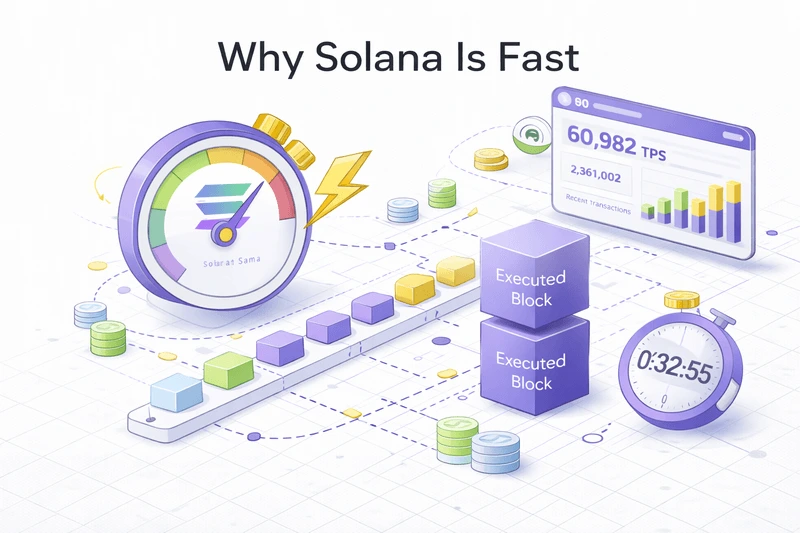
If you’ve ever used Solana, you probably noticed it immediately. Everything feels fast. Transactions confirm quickly, fees stay low, and applications respond without noticeable delay.
This isn’t marketing hype. Solana is built differently from many blockchains. To understand why, it helps to first understand How Solana Works and what architectural decisions make Solana unique.
Why Most Blockchains Are Slow
Many blockchains were not designed for high throughput. They rely on constant coordination between nodes. Every transaction must be ordered, verified, and agreed upon by the network before it can be finalized. As usage increases, that coordination becomes slower and more expensive.
That’s why on many networks, transactions wait in queues, fees spike during congestion, and confirmation times become unpredictable. The core issue is often not computation power. The core issue is coordination.
Solana was designed specifically to reduce this bottleneck.
Solana’s Core Idea: Reduce Waiting
Instead of optimizing older designs, Solana started from a different assumption. What if the network didn’t need to constantly agree on time?
This led to an architecture where time is cryptographically verifiable, transactions don’t wait for ordering in the same way, and execution can happen in parallel. This design choice is a major part of why Solana can feel responsive under load.
Proof of History: Time Without Constant Coordination
At the heart of Solana’s performance is Proof of History. Rather than relying on validators to agree on timestamps, Solana uses a cryptographic process that continuously generates a verifiable sequence of hashes. Each hash proves that a certain amount of time has passed since the previous one.
Because of this, ordering can be established more efficiently. Validators spend less time coordinating on “what happened first,” and more time processing transactions.
Proof of History does not replace consensus. It supports more efficient coordination. For a deeper explanation, see Proof of History Explained.
Parallel Execution Instead of Sequential Processing
Many blockchains process transactions one at a time, even if those transactions do not interact with each other.
Solana works differently. Each transaction specifies which accounts it will read and which accounts it will modify. Because of this, the runtime can execute multiple transactions at the same time when they do not touch the same data.
This is closely connected to Solana’s design choice that “everything is an account.” You can explore that in Solana Accounts Model.
Parallel execution is one of the reasons Solana can handle higher throughput without the same kind of congestion that can appear on sequential systems.
Avoiding Global State Bottlenecks
On many blockchains, smart contracts share global state. That creates bottlenecks because only one transaction can safely modify shared state at a time.
Solana reduces this by keeping application state in separate accounts and requiring transactions to declare their account access up front. That allows the runtime to schedule work more efficiently and minimize unnecessary waiting.
Fast Network Communication
Speed is not only about execution. It also depends on how quickly data moves through the network.
Solana uses specialized networking techniques to distribute data efficiently across validators. Instead of relying on every node sending full blocks to every other node, data can be broken into smaller pieces and propagated in a structured way. This reduces latency and helps the network stay responsive under heavy activity.
Why Solana Can Scale on Layer 1
Many ecosystems rely on Layer 2 systems for scaling, which can add complexity and liquidity fragmentation.
Solana’s approach is to push performance into the base layer. By combining efficient ordering, parallel execution, and high-throughput networking, Solana aims to support a large amount of activity directly on the main chain.
What This Means for Users
All of these design choices translate into a smoother user experience. Transactions confirm quickly, fees remain low, applications feel responsive, and everyday interactions can remain practical even for smaller amounts.
This is one reason Solana is widely used for DeFi, NFTs, gaming, and consumer-facing Web3 applications. If you want to see how performance impacts real use cases, continue with How DeFi Works.
Are There Tradeoffs?
Yes. Solana prioritizes performance and throughput. That generally means validators require more capable hardware, and the protocol includes more performance-oriented complexity than some simpler networks.
The tradeoff is intentional. Solana aims for real-world performance at scale.
Final Thoughts
Solana is fast because it was designed to be fast from the ground up. It focuses on reducing coordination overhead, executing compatible transactions in parallel, and propagating data efficiently across the network.
Solana’s design is also why staking products can feel frictionless. For example, JPool can keep staking interactions fast and low cost.
FAQ
Is Solana fast only because of Proof of History?
Proof of History is a major component, but Solana’s speed also comes from parallel execution, explicit account access, and high-throughput networking.
Why do low fees matter for performance?
Low fees make frequent on-chain actions practical, including trading, rebalancing, and managing DeFi positions with smaller amounts.
Does parallel execution mean every transaction runs at the same time?
No. Transactions can run in parallel only when they do not conflict on the same writable accounts. Conflicting transactions still run in a safe order.
👉 Next recommended articles: