What Is Staking?
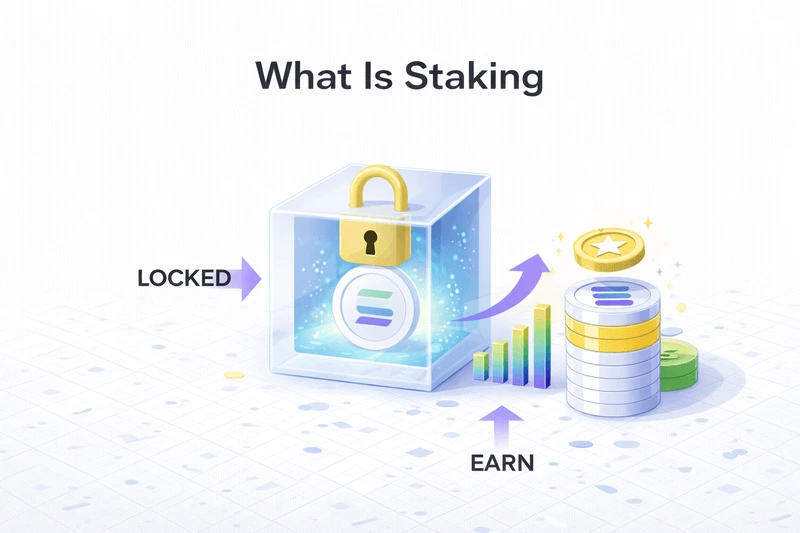
Staking is a way to earn rewards by helping a blockchain network operate securely and efficiently. Instead of using energy-intensive mining, Proof of Stake networks rely on validators and staked tokens to secure the system. Users stake tokens, support network security, and receive rewards over time.
If you’re new to blockchain in general, it helps to first understand What Is Solana and how modern networks operate.
What Staking Means in Practice
At its core, staking is simple. You commit tokens to the network, the network uses that stake as economic security, and rewards are distributed to participants.
In many Proof of Stake systems, staking works through delegation. You choose a validator, you delegate stake, and that validator uses the combined stake to participate in block production and consensus. In return, rewards accrue over time.
It can feel similar to earning interest, but the mechanism is different. You are not lending to a bank. You are participating in how a decentralized network stays secure.
Why Staking Exists
Blockchains need a way to stay secure and agree on transactions without relying on massive computational power.
Proof of Stake aligns incentives by making honest behavior economically rewarded and dishonest behavior costly. The more tokens that are staked, the more expensive it becomes to disrupt consensus. This is why staking is a foundational part of security in many modern networks.
If you want to understand the mechanics step by step, see How Staking Works.
Where Staking Rewards Come From
Staking rewards are not random bonuses. They come from the protocol’s economic design.
Depending on the network, rewards can include newly issued tokens, transaction fees, or other protocol-level distributions. Rewards are then allocated based on how much stake is active and how well validators perform.
For a Solana-specific breakdown, see Solana Staking Rewards.
Is Staking Risk-Free
Staking is often considered a lower-risk crypto strategy compared to active trading, but it is not risk-free.
Common considerations include token price volatility, lockup and unstaking delays, validator performance variability, and smart contract risks if you use liquid staking. Understanding these tradeoffs matters before staking meaningful amounts.
For a detailed overview, see Is Staking Safe?.
Different Ways to Stake
Staking can be done in different ways depending on your goals and how much flexibility you want.
Native Staking
Native staking usually means staking directly through the network’s standard delegation mechanism. You delegate to a validator, rewards accrue over time, and unstaking follows the network’s cooldown rules. This approach is simple and transparent, but your funds are not freely usable while staked.
Liquid Staking
Liquid staking is designed to keep your position usable while you earn staking rewards. Instead of being fully locked, you receive a liquid token that represents your staked position. That token can often be used in DeFi while rewards continue to accrue.
A deeper explanation is available in Liquid Staking on Solana.
Direct Staking
Direct staking emphasizes control over validator selection and delegation. It is often preferred by users who want a simple setup and the ability to choose validators manually.
Instant and Delayed Unstaking
Many liquid staking platforms offer two exit paths. Instant exits depend on available liquidity and usually include a small cost. Delayed exits follow the network’s standard unstaking process and typically have better rates, but they take longer. This gives users a practical choice between speed and efficiency.
Leveraged Staking
Leveraged staking is an advanced strategy that aims to increase exposure to staking yield by combining liquid staking with DeFi borrowing. In simple terms, you stake SOL, receive a liquid staking token, and then use that token as collateral to borrow additional SOL (or a SOL-like asset). The borrowed SOL is staked again, which can increase the total amount earning staking rewards.
This strategy can improve yields, but it also adds meaningful risk. If the collateral value drops or borrowing costs rise, you can face liquidation or reduced profitability. Because of that, leveraged staking is best treated as an advanced approach for users who understand DeFi lending mechanics, liquidation thresholds, and interest-rate dynamics.
For more information, see Leveraged Staking with JPool.
Why People Choose Staking
Staking is popular because it can provide predictable rewards, requires no special hardware, has a relatively low technical barrier, and supports network security. For many users, it is also an entry point into the broader on-chain ecosystem, including DeFi.
Staking vs Holding
Holding means keeping tokens idle and relying only on price appreciation. Staking means putting those tokens to work by supporting the network and earning rewards over time.
A full comparison is covered in Staking vs Holding.
Final Thoughts
Staking is one of the foundations of modern Proof of Stake networks. It allows users to earn rewards, support decentralization, and contribute to network security without operating complex infrastructure.
Whether through native staking or liquid staking platforms like JPool, staking is one of the most accessible ways to participate in Web3.
FAQ
Do I lose control of my tokens when I stake?
In many Proof of Stake systems, staking works through delegation rather than custody transfer. For example on Solana, validators cannot move your SOL just because you delegated stake.
Do staking rewards come from other users?
Generally no. Rewards are usually distributed by the protocol through inflation and fee mechanisms, not by taking funds from other users.
Can I unstake at any time?
You can usually request to unstake at any time, but networks often enforce a cooldown period before funds become transferable again.
Is liquid staking the same as normal staking?
Liquid staking still stakes to validators, but it adds a liquid token representation so you can keep a usable position. This can add smart contract and liquidity risks compared to direct staking.
👉 Next recommended articles: