How Staking Works
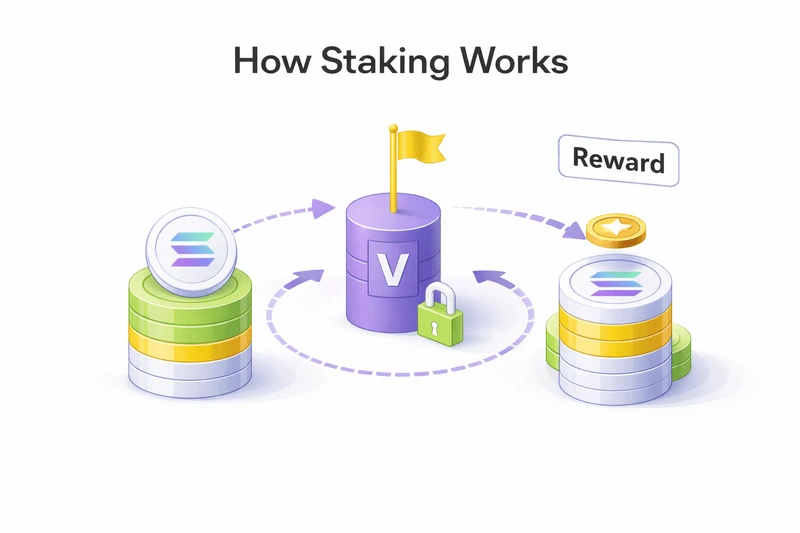
Once you understand what staking is, the next question is straightforward. What actually happens after you stake your tokens?
From the outside, staking looks simple. You stake, you wait, and rewards show up over time. Behind that simple flow is a mechanism that determines when rewards start, why unstaking takes time, and how the network stays secure.
If you’re new to the topic, it helps to start with What Is Staking before going deeper.
What Happens When You Stake Tokens
When you stake tokens, you are not sending them to another person and you are not spending them. Your tokens remain under your control, but they become locked in the staking system and cannot be freely moved while staked.
This lock gives the network economic security. In simple terms, stake is what makes dishonest behavior expensive. That is the foundation of Proof of Stake.
Why Staking Does Not Start Instantly
In most Proof of Stake networks, staking does not become active immediately. Networks operate in fixed time cycles called epochs. When you stake, your tokens are registered and typically become active at the start of the next epoch.
This delay gives the network a clean point to account for active stake before producing the next set of blocks. Once your stake becomes active, it contributes to network security and becomes eligible for rewards.
This epoch structure is part of how networks like Solana stay stable. If you want the broader context, see How Solana Works.
What Your Stake Does Inside the Network
While your tokens are staked, they support validators that secure the blockchain. Validators use stake as their economic backing to validate transactions and produce blocks. The more stake delegated to a validator, the more influence and responsibility it can have in the network.
As a delegator, you do not need to manage these mechanics manually. Your wallet and the protocol handle it in the background. If you want to understand the validator side in more detail, see What Is a Solana Validator.
How Staking Rewards Are Generated
Staking rewards are generated by the protocol. Depending on the network, rewards can come from inflation, transaction fees, or a combination of both.
How much you earn depends on the amount of stake you delegate, how well your validator performs, and broader network conditions. Over time, rewards accrue and increase your staking balance.
If you want a Solana-specific breakdown, see Solana Staking Rewards.
Why Unstaking Takes Time
A common question is why you cannot always withdraw instantly. When you request to unstake, your tokens usually enter a cooldown period. During this time they stop earning rewards, but they remain locked. Once the cooldown ends, they become transferable again.
This design helps protect the network from sudden mass exits and makes consensus more stable during volatile periods.
Instant vs Delayed Unstaking
Some liquid staking platforms offer an instant exit by using available liquidity. This can let users unstake immediately, usually with a small cost such as a fee or a less favorable exchange rate.
Standard unstaking follows the network’s native rules and takes longer, but it is often the most straightforward option for long-term participants. Both approaches exist to give users flexibility depending on their goals.
Why Understanding Staking Matters
Many users stake without understanding the mechanics. That can lead to confusion when rewards do not appear immediately or when withdrawals take time.
Once you understand epochs, activation, reward accrual, and unstaking, staking becomes predictable. You know what to expect and how to plan your liquidity. This is especially useful if you plan to combine staking with DeFi strategies, which is explained in How DeFi Works.
Final Thoughts
Staking follows a simple but carefully designed process. Tokens are locked to secure the network. Rewards accrue over time. Unstaking includes a delay that protects the system.
Nothing in this flow is accidental. Each step exists to balance security, decentralization, and usability. Platforms like JPool build on top of these mechanics to make staking more flexible and accessible while keeping the underlying staking model intact.
FAQ
Why do I have to wait for rewards to start?
Because many Proof of Stake networks activate stake on epoch boundaries. Your stake is registered first and becomes active at the start of the next epoch.
Why does unstaking take time?
The cooldown period helps the network stay stable by preventing sudden exits that could weaken security. During cooldown, stake is leaving the active set in a controlled way.
Is staking the same as lending?
No. Staking secures the network through Proof of Stake. Lending is a DeFi activity where you supply assets to a protocol to earn interest from borrowers.
👉 Next recommended articles: