Product News & Solana Staking Updates
Fresh thinking on liquid staking, validators, rewards, DeFi integrations, and the Solana ecosystem.

Most guides on instant vs. delayed unstaking in Solana liquid staking stop at the fee comparison. What they skip is the part that actually determines your outcome: when, inside an epoch, you press the button. That timing — not just the exit method you pick — governs both how long you wait and the exchange […]

Most stakers assume an incentive campaign works like a savings account with a bonus rate: join, earn, leave whenever, keep everything you’ve accrued. That assumption is wrong often enough to matter. JPool’s incentive campaigns can attach a time-decay penalty to early departures — and because the mechanic is opt-in per campaign and easy to overlook, […]

Most discussions of Solana leveraged staking treat Health Factor as a single number to glance at occasionally. That framing misses what the metric actually is: a graduated early-warning system with distinct decision points, not a binary pass/fail gauge. This is a fundamentally different mechanism from validator-side bond health coverage — this piece is about what […]

There was a moment — somewhere between 2020 and 2023 — when the DeFi market collectively decided that governance tokens were the crypto equivalent of equity. The logic seemed sound: you hold tokens, you vote on protocol decisions, the protocol generates fees, therefore you own a piece of the protocol. This framing drove billions in […]

There is a governance decision embedded in every liquid staking deposit that almost no staker consciously makes. When you stake SOL into a liquid staking pool, you are not simply earning yield. You are delegating authority over which validators receive network weight — and by extension, which operators shape Solana’s consensus, which infrastructure philosophies get […]

There is a moment every emissions-driven DeFi protocol eventually reaches. The token price that made the APY look attractive begins to compress. The treasury runway shortens. The community debates whether to extend, reduce, or restructure the reward program. And then, quietly, the emissions stop. Table of Contents The Emissions Cliff: A Structural Problem, Not a […]

There is a structural irony embedded in how DeFi collateral markets evolve. The assets that earn a reputation for safety attract the most borrowing demand. That demand drives deeper liquidity, which attracts more protocols to accept them. Over time, the “safe” asset becomes so deeply embedded in the collateral stack that its failure — however […]

When a DeFi protocol advertises “stacking yields,” it is making an implicit accounting claim: that multiple yield sources can be combined additively without increasing the underlying risk profile. That claim deserves forensic scrutiny. Because when you trace each layer of a recursive yield chain back to its source, the math rarely adds up the way […]

For most of DeFi’s early history, the implicit assumption was simple: non-custodial protocols are compliance-neutral by default. If no intermediary holds user funds, no intermediary can be compelled to freeze, report, or restrict them. That assumption no longer holds in 2026. Table of Contents AML Enforcement Has Changed Its Target The Two-Layer Problem: Access vs. […]

DeFi governance is frequently described as a feature — decentralized communities steering protocol evolution. In practice, token-weighted voting has created an entirely new attack surface: one where capital accumulation, quorum manipulation, and fork credibility threats function as financial weapons. This is DeFi governance arbitrage, and it is one of the most underexplored structural risks in […]

For years, the automated market maker was the backbone of on-chain liquidity. Today, a structural shift in how trades are routed is quietly eroding the revenue that made passive LP positions viable — and the implications for DEX revenue quality, intent-based DeFi liquidity, and protocol revenue sustainability on Solana are more significant than most participants […]

There is a number that dominates DeFi headlines more than any other: Total Value Locked (TVL). Protocols compete to display it. Aggregators rank by it. Investors use it as a proxy for health. But beneath the surface of many high-TVL ecosystems lies a structural vulnerability that rarely gets named directly—recursive collateral risk, the condition where […]
Community-driven evaluation of the Community Good program Table of Contents Why? How the Council Works Composition Term and Rotation Compensation and Independence What Changes for CG Validators The Council’s First Task How to Apply Why? The Community Good (CG) program distributes 30% of JPool’s stake among validators who bring real impact to the Solana ecosystem. […]
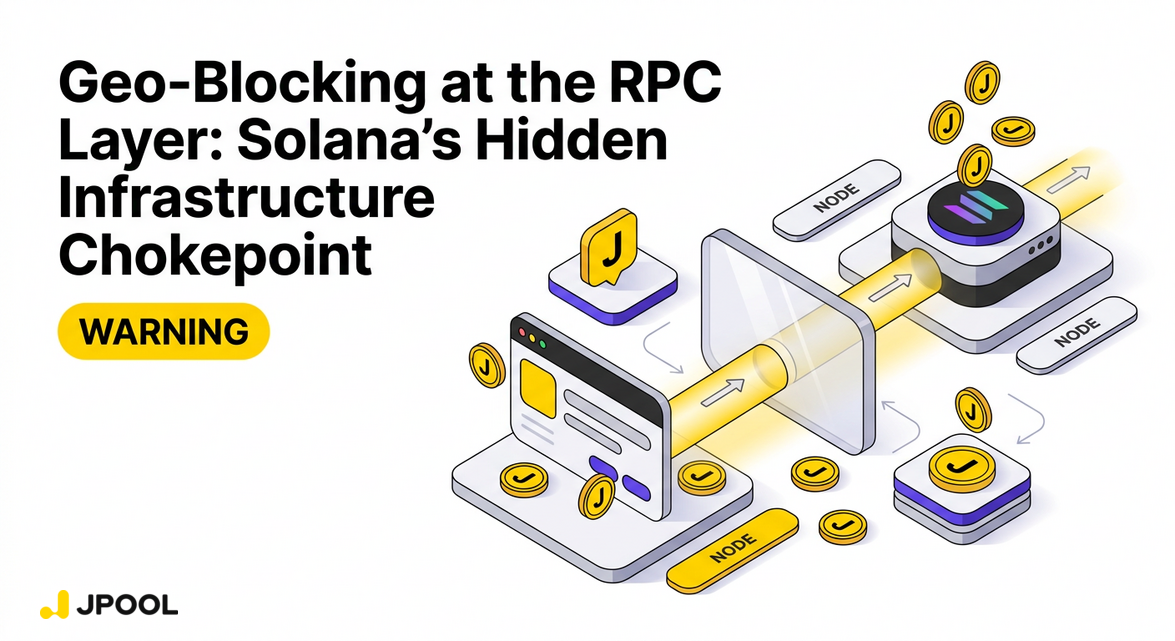
Every discussion of Solana decentralization eventually arrives at validators — how many there are, how stake is distributed, whether any single operator controls too much. That conversation is necessary. It is also incomplete. Table of Contents The RPC Layer: Solana’s Invisible Chokepoint How Geo-Blocking Propagates Through the Staking Stack The Three Failure Scenarios No One […]
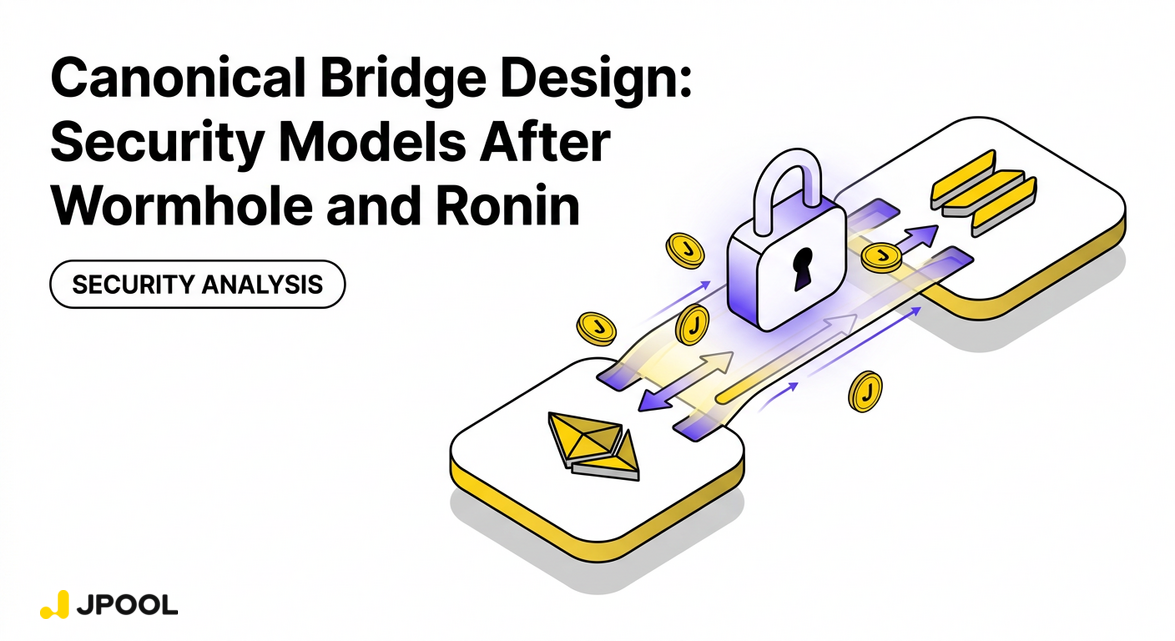
The two largest bridge exploits in DeFi history — Wormhole ($320M, February 2022) and Ronin ($625M, March 2022) — were not random failures. They were predictable outcomes of specific architectural decisions. Understanding why requires going deeper than the post-mortems: it requires examining the verification models that canonical bridges rely on, the trust assumptions those models […]
- «
- ‹