How Solana Works
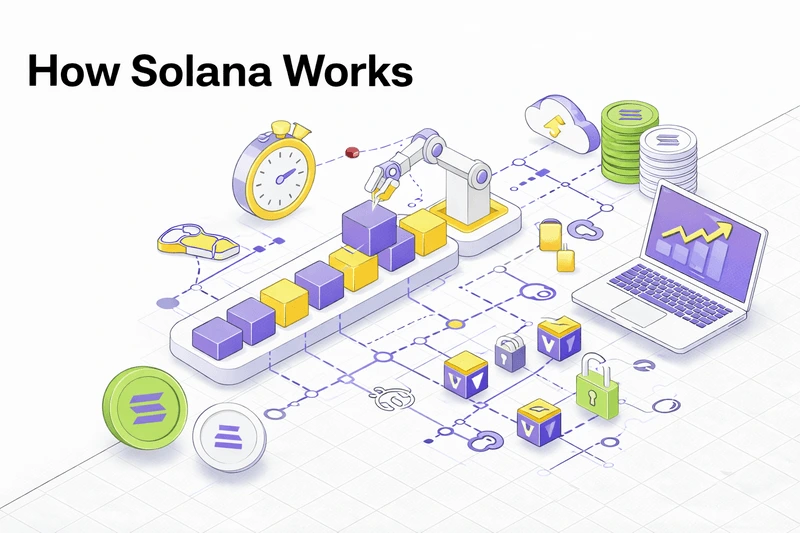
Solana is often described as one of the fastest blockchains in the world. It can process a large number of transactions, confirm them quickly, and keep fees low even during high network activity.
But how does Solana actually achieve this?
To understand why Solana is different, it helps to first understand what Solana is and what problems it was designed to solve. If you’re new to the topic, start with What Is Solana.
Why Traditional Blockchains Are Slow
Most blockchains face a fundamental coordination problem. Before processing transactions, nodes need to agree on what happened first. That constant coordination takes time and creates bottlenecks, especially when the network gets busy.
As demand increases, transactions slow down, fees increase, and users have to wait. This is what happens on many older blockchains during periods of high demand. Solana approaches the problem differently.
The Core Idea Behind Solana
Solana introduces a simple idea:
Instead of asking the network what happened first, Solana proves it cryptographically.
This innovation is called Proof of History, and it plays a central role in Solana’s performance. By establishing a verifiable ordering of events before consensus is reached, Solana reduces one of the biggest sources of overhead in traditional blockchains.
A deeper explanation is covered in Proof of History.
Proof of History: Solana’s Internal Clock
Proof of History (PoH) is not a consensus mechanism. It is a cryptographic way to measure time and establish ordering.
Solana continuously generates a sequence of hashes where each hash depends on the previous one. Because this sequence cannot be easily skipped or rewritten, it functions like a trustless clock for the network.
This means that transactions can be ordered reliably, validators spend less time on constant synchronization, and the network wastes less time on coordination.
In simple terms, the network has a shared way to agree on ordering without extra communication for every step.
How Solana Uses Proof of Stake
While Proof of History handles ordering, Solana uses Proof of Stake (PoS) to secure the network. Validators are responsible for producing blocks, validating transactions, and maintaining network integrity.
Users can delegate SOL to validators, which helps secure the network and earns rewards in return. If you’re not familiar with how this works, it’s explained step by step in:
If you want to stake SOL and keep liquidity for DeFi, you can do that through JPool.
What Happens When You Send a Transaction
When you send a transaction on Solana, the flow is straightforward.
First, the transaction is signed and sent to the network. Then it is forwarded to the current leader, which is the validator responsible for producing the next block. Using Proof of History, the transaction can be placed in an ordered timeline. After that, many transactions can be executed in parallel rather than one by one.
Once execution is complete, the result is broadcast across the network and finalized, often within seconds. This is why Solana can feel very fast compared to many other blockchains.
Parallel Execution with Sealevel
One of Solana’s biggest technical advantages is its execution engine called Sealevel. Unlike many blockchains that process transactions sequentially, Solana can run many smart contract interactions at the same time.
This works because each transaction explicitly defines which accounts it reads and which accounts it modifies. If two transactions don’t touch the same accounts, they can be processed simultaneously.
This architecture is a major reason Solana performs well in DeFi applications. If you want the DeFi side of the picture, see How DeFi Works.
Fast Data Sharing with Turbine
Speed is not only about computation. It is also about communication.
Solana uses a protocol called Turbine to distribute data efficiently across the network. Instead of sending entire blocks to every node, Solana splits data into smaller pieces, distributes them across validators, and allows nodes to forward parts of that data onward.
This reduces bandwidth pressure and helps the network scale more effectively.
Optimized Storage with Cloudbreak
To handle large amounts of state efficiently, Solana uses a storage layer called Cloudbreak. It is designed to support fast parallel reads and writes, efficient memory usage, and high throughput under load.
This is one reason Solana can support applications that require frequent updates, including DeFi protocols, NFT platforms, and real-time apps.
Why Solana Is Fast
Solana’s speed comes from combining multiple design choices:
- Proof of History for ordering,
- Proof of Stake for security,
- Sealevel for parallel execution,
- Turbine for data propagation,
- Cloudbreak for storage efficiency.
Instead of relying on separate scaling layers, Solana pushes performance improvements into the base layer. If you want a focused explanation, see Why Solana Is Fast.
Is Solana Decentralized?
Solana is decentralized, but its design prioritizes performance. Because the network is built for high throughput, validators generally require more capable hardware than on some other networks. This can affect how easy it is for operators to run validators, but it also supports real-world usability at scale.
To understand this tradeoff better, see:
Final Thoughts
Solana works differently from many blockchains. By rethinking ordering, execution, and data propagation, it can support fast transactions, low fees, high scalability, and strong developer flexibility.
This architecture is a big part of why Solana is widely used for DeFi, staking, and high-performance Web3 applications.
FAQ
Is Proof of History the same as consensus?
No. Proof of History is a way to establish ordering with a cryptographic clock. Consensus is achieved through validator participation with Proof of Stake.
Why can Solana process transactions in parallel?
Because transactions specify which accounts they read and write. If transactions don’t touch the same accounts, the runtime can execute them at the same time.
Why do low fees matter for DeFi?
Lower fees make frequent actions practical, including rebalancing, trading, and managing positions with smaller amounts.
👉 Next recommended articles: