What Is a Solana Validator?
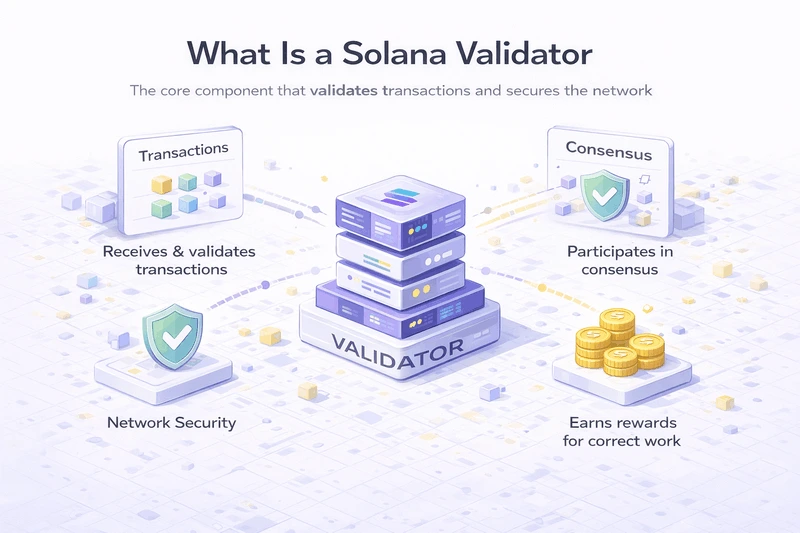
If you have ever sent a transaction on Solana, staked SOL, or used a DeFi application, you have already interacted with validators, even if you didn’t notice it. Validators are the backbone of the Solana network because they keep the blockchain running, secure, and synchronized.
Understanding what validators do helps you understand staking, rewards, and how Solana achieves its performance.
What a Solana Validator Really Is
A Solana validator is a server running Solana’s core software that actively participates in the network. Its job is to verify transactions, produce and validate blocks, participate in consensus, and help keep the blockchain secure.
Unlike mining-based blockchains, Solana does not rely on computational power to decide who can create blocks. Instead, validators participate through Proof of Stake, using delegated SOL as economic security. Validators that operate reliably earn rewards, and validators that perform poorly can earn less and lose reputation over time.
Why Validators Are Essential
Every blockchain needs a way to agree on what is true. On Solana, validators make sure transactions are valid, blocks are produced correctly, the network stays synchronized, and malicious behavior is rejected.
Without validators, Solana simply would not function. Validators make decentralization possible while still supporting the network’s high performance.
How Validators Work on Solana
Solana combines Proof of Stake with Proof of History. Proof of History provides a verifiable ordering of events, and Proof of Stake determines which validator is scheduled to produce blocks.
This combination helps Solana reduce coordination overhead and maintain high throughput.
If you want to understand the mechanism in more depth, see How Solana Works and Proof of History Explained.
How Validators Earn Rewards
Validators earn rewards from network inflation and transaction fees. Those rewards are shared with users who delegate SOL to the validator.
Each validator sets a commission rate, which determines what portion of rewards the validator keeps before distributing the remainder to delegators. This is why validator selection matters, because performance and commission affect your returns.
A deeper explanation is available in Validator Commission Explained.
What Happens When You Stake SOL
When you stake SOL, you are not sending tokens to the validator. You are delegating stake to that validator.
Your SOL remains under your control, but it is counted as part of the validator’s total stake. This increases the validator’s influence and helps secure the network. In return, you receive a share of the rewards the validator earns.
If you want the full breakdown, see How Staking Works.
Why Choosing a Validator Matters
Not all validators perform equally. Differences in uptime, infrastructure quality, commission rates, and operational reliability can affect your rewards and the overall health of the network.
Choosing a strong validator can help you earn more consistent rewards, reduce downtime-related reward drops, and support better stake distribution.
To explore real validator performance and statistics, you can use the live dashboard in Solana Validator Dashboard.
Are Solana Validators Centralized?
Solana aims to be decentralized, but decentralization depends on stake distribution. If too much stake is concentrated on a small number of validators, the network can become less resilient.
That’s why spreading stake across reliable validators matters. Delegating responsibly can improve network security, increase censorship resistance, and strengthen Solana’s infrastructure.
Validator vs Node: What’s the Difference?
Not every node is a validator. A node can observe the network and relay information. A validator actively participates in consensus and earns rewards.
Only validators produce blocks, vote on transactions, and receive staking rewards. This distinction helps explain why validator performance matters for everyday network activity.
Why Validators Matter to Users
Even if you never run a validator yourself, your experience depends on them. Fast confirmations, low fees, and network stability rely on validators doing their job correctly.
When you stake SOL, you are supporting the infrastructure that keeps Solana usable.
Final Thoughts
Validators are the foundation of the Solana network. They secure the blockchain, process transactions, enable staking, and help keep the system decentralized.
Understanding how validators work helps you make smarter staking decisions and better understand how Solana achieves its performance.
FAQ
Can a validator take my SOL if I stake with them?
No. Delegation does not give validators custody of your funds. Your SOL remains under your control, and the validator cannot move it.
What determines how much a validator earns?
Earnings depend on validator performance, network-wide reward mechanics, and how rewards are shared after commission.
Why does decentralization depend on validator choice?
Because stake concentration affects resilience. Spreading stake across reliable validators reduces over-centralization and supports network health.
👉 Next recommended articles: