Proof of History
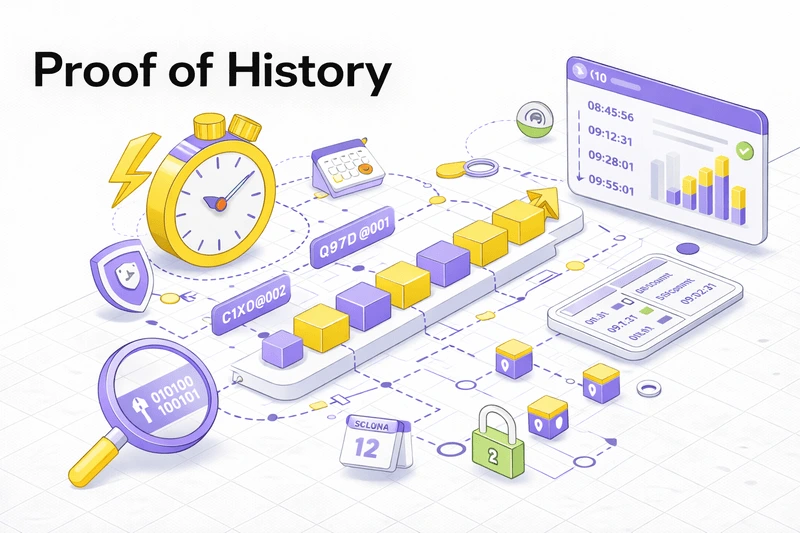
When people ask why Solana is so fast, the answer often leads to the same concept: Proof of History. At first glance it can sound overly technical, but the idea behind Proof of History is simpler than it seems. It does not try to replace consensus or reinvent mining. It solves a specific problem that has limited blockchains for years.
To understand why Proof of History matters, it helps to first understand how Solana works as a whole. If you haven’t read it yet, start with How Solana Works.
The Problem Solana Needed to Solve
Every blockchain faces a fundamental challenge: transactions must be ordered correctly.
One user sends a transaction, another follows, and the network must agree on which came first. On many blockchains, reaching that agreement requires constant communication between nodes.
Validators exchange messages, compare timing assumptions, and repeatedly synchronize state. As activity grows, this coordination becomes slower and more expensive. The more users the network has, the more time it spends agreeing on what happened and in what order.
Solana approached this problem from a different angle.
A Different Way to Think About Time
Instead of asking the network to agree on time, Solana asked a simpler question: what if time itself could be proven?
This idea led to Proof of History. Rather than relying on external clocks or repeated validator coordination, Solana uses a cryptographic process that produces a continuous, verifiable sequence of outputs. Anyone can verify the sequence, and it is not practical to alter without being noticed.
In other words, Proof of History helps the network establish ordering without having to constantly ask every node to coordinate on it.
What Proof of History Actually Is
Proof of History is not a consensus mechanism. It does not replace Proof of Stake and it does not decide who produces blocks. Proof of History is best understood as a cryptographic timestamping and ordering system.
It works by continuously computing a sequence where each output depends on the previous one. Because this sequence cannot be generated out of order, it provides a verifiable notion of time passing. Transactions can then be referenced within that sequence so the network can agree on ordering more efficiently.
You can think of it as Solana’s internal clock, a clock that can be verified by other validators.
Why This Improves Performance
If ordering can be verified more directly, the network can reduce the amount of time spent on coordination. Validators do not need as many back and forth rounds just to agree on ordering. That lowers overhead and helps the network move faster under load.
This is one of the reasons Solana can process large volumes of transactions while keeping fees low in many situations. For a focused explanation of performance, see Why Solana Is Fast.
How Proof of History Works With Proof of Stake
Proof of History does not replace Proof of Stake. The two systems work together.
Proof of History helps establish when events occurred in an ordered timeline. Proof of Stake determines who participates in validation and how consensus decisions are finalized through validator voting and stake-weighted security.
A useful mental model is that Proof of History provides the ordering signal, and Proof of Stake provides the security and finality process. If you want to understand the staking side, see:
Why Proof of History Makes Solana Feel Fast
On many blockchains, delays often come from coordination. Nodes wait for messages, blocks wait for confirmations, and transactions queue up while the network agrees on ordering.
On Solana, Proof of History reduces some of that waiting by providing a verifiable ordering reference. This helps validators execute transactions more efficiently, and it supports Solana’s ability to process many operations quickly, especially when combined with Solana’s parallel execution design.
That’s why Solana can feel fast not only in theory, but also in everyday use.
Is Proof of History Secure?
Proof of History relies on a cryptographic sequence that is designed to be easy to verify and difficult to fake. Because each step depends on the previous step, rewriting the sequence would require recreating the work in a way that other validators can detect when it does not match expected history.
This makes Proof of History useful as an ordering mechanism, while Solana still relies on Proof of Stake validators and consensus voting to secure the chain.
Why Proof of History Matters for Users
Even if you never think about blockchain architecture, Proof of History affects your day-to-day experience on Solana. It supports faster confirmations, helps keep fees lower than they would be on slower designs, and makes many on-chain applications feel more responsive.
In practice, it is one of the design choices that helps Solana aim for a smoother experience for DeFi, staking, and consumer apps.
That same performance is what makes day-to-day staking and liquid staking apps feel responsive on Solana, including JPool.
Final Thoughts
Proof of History is one of the innovations that makes Solana different. Instead of relying on constant coordination to establish ordering, Solana uses a verifiable sequence to reduce overhead. When combined with Proof of Stake, this design helps the network stay fast while still being secured by validators.
Once you understand Proof of History, the rest of Solana’s architecture becomes easier to follow.
FAQ
Is Proof of History the same as Proof of Stake?
No. Proof of History helps with ordering events in time. Proof of Stake is the security mechanism that determines validator participation and helps the network reach consensus.
Does Proof of History replace consensus?
No. Solana still uses validators and stake-weighted voting for consensus. Proof of History helps reduce coordination overhead by providing a verifiable ordering reference.
How does Proof of History help fees stay low?
By reducing coordination overhead and supporting higher throughput, the network can handle more activity per unit of time. That can help keep fees lower than on slower systems, although fees still depend on network usage.
👉 Next recommended articles: