Solana Staking Rewards
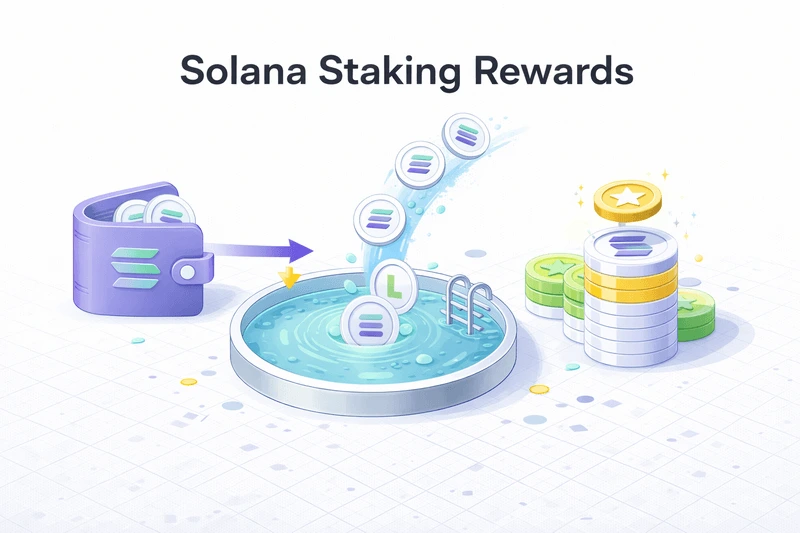
Staking SOL is often described as a way to earn passive income, but it works differently from traditional interest or savings products. Rewards are not fixed, APY changes over time, and the amount you earn depends on several moving parts inside the Solana network.
To understand what you can realistically expect from staking SOL, it helps to first understand How Staking Works and how Solana distributes rewards.
Where Solana Staking Rewards Come From
Solana staking rewards are generated by the protocol.
They come from two primary sources: network inflation and transaction fees. New SOL is issued according to Solana’s monetary schedule and distributed to validators and delegators who help secure the network. A smaller portion of rewards can also come from transaction fees paid by users.
This means staking rewards are not promotional bonuses or temporary incentives. They are part of how Solana maintains security and decentralization.
What APY Really Means on Solana
APY, or Annual Percentage Yield, is an annualized estimate of what you could earn if rewards were compounded.
On Solana, staking APY is not fixed. It changes based on how much SOL is staked, the inflation schedule, validator performance, and overall network activity. Because of this, APY should be treated as an estimate rather than a promise.
When more users stake SOL, rewards are shared among more participants and the average APY tends to decrease. When less SOL is staked, the average APY tends to rise.
Why Staking Rewards Change Over Time
It is normal for staking rewards to fluctuate.
One reason is Solana’s inflation schedule, which changes over time. Another is the total amount of SOL staked. As the staked supply changes, rewards per participant change too.
Validator performance also matters. Validators with higher uptime and more consistent voting tend to generate more consistent rewards for delegators.
This is why choosing a reliable validator often matters more than chasing the highest displayed APY. For a practical guide, see How to Choose a Solana Validator.
How Rewards Are Calculated
Solana calculates staking rewards on an epoch basis.
An epoch lasts several days. During each epoch, the network measures active stake, validator participation, and validator performance. At the end of the epoch, rewards are distributed automatically.
Because of this structure rewards do not appear instantly, staking does not become active immediately, and rewards can vary slightly from epoch to epoch.
This behavior is expected and is part of how Solana stays stable.
Validator Commission and Its Impact
When you stake SOL, you delegate it to a validator. Validators take a commission from the rewards they generate. For example, a validator with a 5% commission passes 95% of rewards to delegators.
A lower commission does not always mean higher rewards. Validator uptime, reliability, and infrastructure quality can matter just as much.
This is explained in more detail in Validator Commission Explained.
Liquid Staking Rewards
Liquid staking works differently from direct staking.
Instead of seeing rewards added to a delegated stake account, you receive a liquid staking token whose value reflects your staked SOL plus accumulated rewards. The main advantage is flexibility. You can earn staking rewards while keeping an asset that can be used across DeFi.
You can explore liquid staking here: 👉 JPool
For a deeper explanation, see Liquid Staking on Solana.
Why Your Rewards May Look Lower Than Expected
Many users notice that their realized rewards do not match the displayed APY exactly.
This often happens because rewards are calculated per epoch, APY is annualized, staking activates on epoch boundaries, compounding depends on the method used, and validator performance varies over time.
These differences are normal. The important part is to evaluate rewards over multiple epochs rather than judging a single short window.
Is Staking Risk-Free?
Staking is often considered a lower-risk way to earn yield in crypto, but it is not risk-free.
The main risks include SOL price volatility, temporary lockups, smart contract risk in liquid staking, and protocol-level changes. If you want a deeper look at potential downsides, see Is Staking Safe?.
What Is a Good Staking APY?
There is no universal “best” APY.
A healthy staking yield is one that is sustainable, aligned with network inflation and participation, and consistent over time rather than driven by short-term incentives. Extremely high APY is often a sign of additional risk or temporary conditions.
Final Thoughts
Solana staking rewards are designed to balance security, decentralization, and long-term sustainability. Your returns depend on the amount of SOL staked, how long you remain staked, validator performance, and overall network conditions.
Staking tends to work best as a long-term strategy rather than a short-term yield chase. Platforms can make staking easier by combining rewards with liquidity and transparency while staying aligned with Solana’s core staking mechanics.
FAQ
Why does Solana staking APY change so often?
Because rewards depend on network inflation, total SOL staked, validator performance, and network activity. These inputs change over time, so the annualized estimate changes too.
Do I need to claim rewards manually?
With direct staking, rewards are typically reflected in your delegated stake over time. With liquid staking, rewards are reflected in the value of the liquid token. In both cases, users usually do not need to claim rewards manually.
Why did my rewards not start right away?
Stake usually becomes active at an epoch boundary. If you stake in the middle of an epoch, you may wait until the next epoch for rewards to start accruing.
Does lower validator commission always mean higher rewards?
Not necessarily. Commission is only one factor. Reliability and performance can have a larger impact on what you actually earn.
👉 Next recommended articles: