How to Choose a Solana Validator
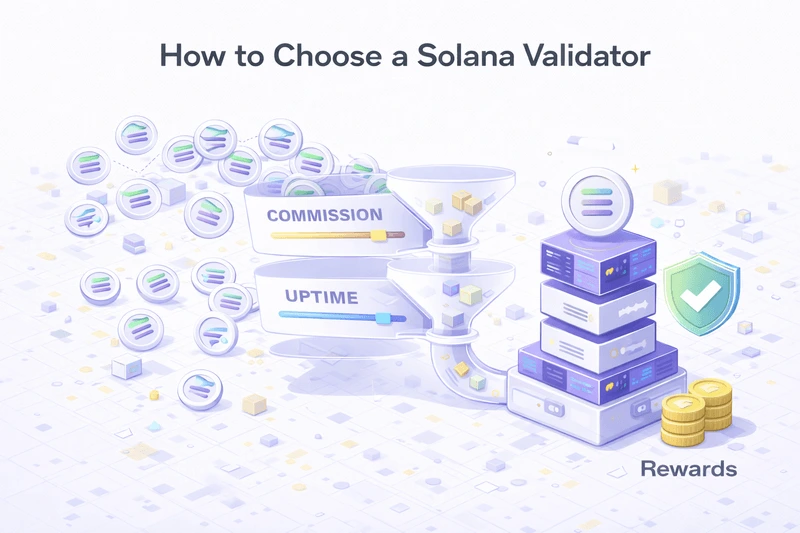
Choosing a validator is one of the most important decisions you make when staking SOL, and at the same time one of the most misunderstood. At first glance, validators look similar. They run the same software, operate on the same network, and often appear to offer comparable returns.
In reality, your choice affects your rewards, your reliability, and even the decentralization of the Solana network. This article explains how to choose a validator properly without technical overload or misleading shortcuts.
What Choosing a Validator Really Means
When you stake SOL, you are not staking “to Solana” itself. You are delegating your tokens to a specific validator. That validator represents your stake in the network, participates in consensus on your behalf, and earns rewards that are then shared with you.
Your SOL never leaves your wallet, but your rewards depend on how well that validator performs. This is why validator choice matters far more than most people realize.
The Most Common Mistake
The most common mistake is choosing a validator based only on the lowest commission. At first glance this seems logical. Lower commission should mean higher returns.
In practice, it often leads to the opposite result. A validator with poor uptime, unstable infrastructure, or missed votes can earn significantly less, even with zero commission, than a reliable validator charging a reasonable fee. Staking is about consistency, not chasing the smallest number.
What Actually Matters When Choosing a Validator
The most important factor is reliability. A good validator stays online consistently, votes on time, maintains stable infrastructure, and operates transparently.
When a validator underperforms, rewards drop for everyone who delegated to it. This is why performance history matters more than advertised returns.
Why Commission Should Be Reasonable, Not Minimal
Validator commission exists for a reason. Running a validator requires high-performance servers, constant monitoring, security maintenance, network bandwidth, and ongoing operational costs.
Validators with unrealistically low commission often cannot sustain this long term. Some raise commission later, others simply disappear. A reasonable, stable commission is often a sign of a healthy validator operation.
Stake Distribution Matters More Than People Think
Decentralization depends on how stake is distributed across validators. If most stake is concentrated on a few large validators, the network becomes less resilient and more centralized.
By choosing mid-sized, reliable validators instead of the biggest ones, you help improve decentralization, strengthen network security, and reduce systemic risk. This benefits the entire ecosystem, including you.
Transparency Is a Strong Signal
Good validators are usually transparent about how they operate. They publish performance metrics, communicate changes, and keep commission adjustments predictable.
Validators with no public information, unclear policies, or constantly changing terms should be approached with caution.
How to Compare Validators Properly
The best way to choose a validator is to look at real data, not marketing claims. A validator dashboard allows you to compare uptime, total stake, commission, historical performance, and participation consistency.
You can explore all of this in one place here:
This gives you an objective view of how validators actually perform on the network.
A Simple Rule That Works
If you want one practical rule to follow, it’s this:
Choose a validator with stable performance, reasonable commission, and a long-term track record, not the lowest fee.
This approach consistently leads to better staking outcomes.
Why Validator Choice Matters Long-Term
Your validator affects how consistent your rewards are, how secure the network remains, how decentralized Solana stays, and how predictable your staking experience is.
Staking is not just about earning yield. It is also about participating in the health of the network.
Final Thoughts
Choosing a validator is one of the few decisions in staking that truly matters. A good validator won’t promise miracles. They will operate reliably, epoch after epoch.
That reliability is what turns staking into a stable, long-term strategy rather than a guessing game.
FAQ
What should I check first when choosing a validator?
Start with reliability metrics like uptime and voting consistency, then check commission stability and a clear operating track record.
Is a 0% commission validator always best?
Not necessarily. Poor performance can reduce rewards more than a small commission, so reliability often matters more than the lowest fee.
How often should I review my validator choice?
Periodically. Performance and commission can change over time, so it’s worth checking occasionally to make sure your validator still meets your expectations.
👉 Next recommended articles: