Liquid Staking on Solana
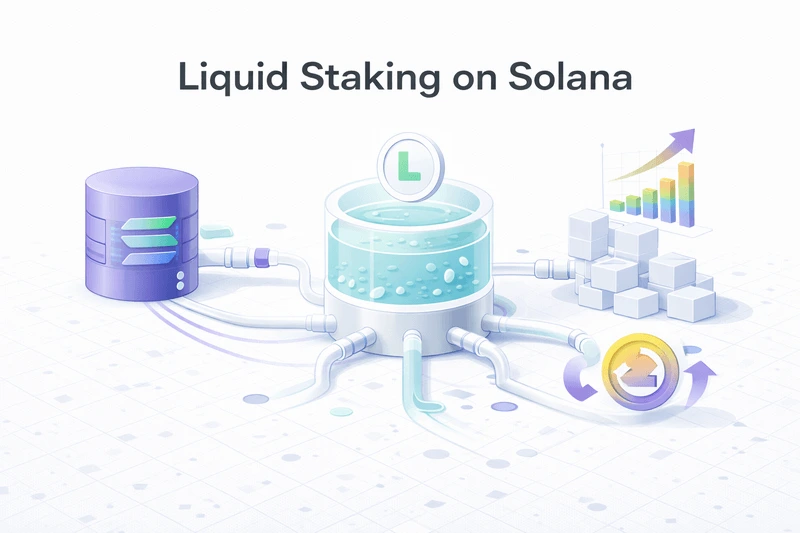
Liquid staking is one of the most important innovations in modern staking. It solves a simple problem: how to earn staking rewards while keeping your assets flexible.
On Solana, liquid staking lets you stake SOL while keeping liquidity. That makes staking more practical for real-world use, especially for users who want to participate in DeFi without giving up staking yield.
If you’re new to staking in general, it helps to start with What Is Staking before diving deeper.
What Liquid Staking Actually Means
Traditional staking usually locks tokens for a period of time. During that time, the assets cannot be transferred, traded, or used in DeFi.
Liquid staking changes the model. When you stake SOL through a liquid staking protocol, you receive a liquid token that represents your staked position. That token can remain usable across the ecosystem while staking rewards continue to accrue.
In simple terms, your SOL can keep earning without feeling frozen.
Why Liquid Staking Exists
Classic staking secures a network, but it creates a limitation: capital becomes less usable once it is staked. Locked tokens cannot easily be used for trading, lending, providing liquidity, or interacting with DeFi protocols.
Liquid staking improves capital efficiency. You can keep a usable token while still supporting validators and earning rewards. This is why liquid staking has become a core part of many Proof of Stake ecosystems and is closely connected to DeFi use cases. For the DeFi side, see How DeFi Works.
Example of a Liquid Staking Platform on Solana
Solana supports liquid staking through protocols such as JPool.
Using JPool, users can stake SOL and receive a liquid staking token in return. This token represents their staked SOL plus accumulated rewards and can often be used across DeFi while continuing to earn yield.
From a user perspective, the flow is straightforward. You stake SOL, you receive a liquid token, and you can keep using that token while rewards accrue in the background.
How Liquid Staking Works in Practice
When you stake SOL through a liquid staking protocol, the protocol delegates SOL to validators on your behalf. In exchange, you receive a token that reflects your deposited SOL, your share of the staking pool, and the rewards that accumulate over time.
As rewards accrue, the liquid staking token represents a growing claim on underlying SOL. You can hold it, use it in DeFi, or exchange it back for SOL when you want to exit.
Some advanced strategies build on top of this. Leveraged staking is one example. It combines liquid staking with DeFi borrowing to increase exposure to staking yield, and it adds additional risk, so it is best treated as an advanced approach.
Instant vs Delayed Unstaking
Liquid staking platforms often offer two ways to exit.
Instant unstaking can return SOL immediately using available liquidity. This is fast, but it usually comes with a small fee or a slightly reduced rate.
Delayed unstaking follows the network’s native unstaking process. It takes longer, but it is typically more cost-efficient and does not depend on liquidity being available.
This connects directly to the mechanics described in How Staking Works.
Why Instant Unstaking Has a Cost
Instant exits require liquidity to be available right now. When a protocol provides SOL upfront, it takes on short-term liquidity and flow risk. A small fee or rate adjustment helps balance that demand and keep the system stable.
Delayed unstaking avoids this cost because it follows the standard on-chain cooldown process.
How Rewards Work in Liquid Staking
With liquid staking, rewards are usually not paid out manually. Instead, the value of the liquid staking token reflects rewards over time.
That means no manual claiming, automatic compounding, and transparent tracking through the token’s relationship to underlying SOL.
If you want a detailed breakdown of reward mechanics, see Solana Staking Rewards.
Risks to Consider
Liquid staking is widely used, but it is not risk-free.
The main risks include smart contract vulnerabilities, liquidity shortages during high demand, protocol-level risks, and market volatility. Using established platforms can reduce avoidable risk, but it still helps to understand how the system works before committing funds.
For the broader risk picture, see Is Staking Safe?.
Liquid Staking vs Traditional Staking
Traditional staking is simpler, but it locks funds and limits flexibility. Liquid staking keeps your position usable while maintaining staking rewards. That combination is why liquid staking has become one of the most powerful tools in the Solana ecosystem.
Final Thoughts
Liquid staking represents the evolution of staking on Solana. It lets users earn rewards, stay liquid, and participate in DeFi at the same time, while still supporting network security through validator delegation.
FAQ
Do I stop earning rewards if I use my liquid staking token in DeFi?
Usually no. The liquid token represents your staked position, so rewards can keep accruing in the background even while the token is used elsewhere. The exact behavior depends on the protocol and integrations.
Can I always unstake instantly?
Not always. Instant exits depend on available liquidity. If liquidity is limited, you may need to use delayed unstaking.
Is liquid staking riskier than direct staking?
It can be. Liquid staking introduces smart contract and liquidity risks on top of normal staking considerations. Direct staking is simpler, but less flexible.
👉 Next recommended articles: