Validator Commission
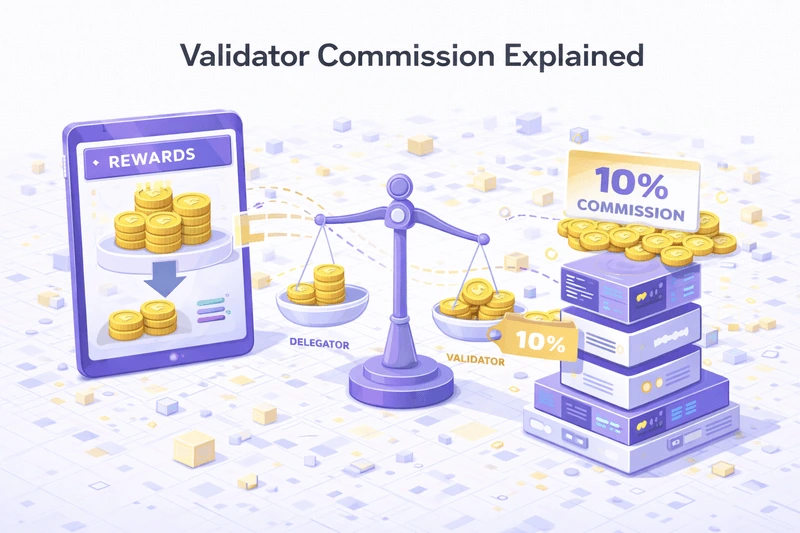
When people start staking SOL, one of the first numbers they notice in validator lists is commission. Some validators show 0%. Others show 5%, 8%, or even higher.
At first glance, it seems like a lower commission must mean higher profit. In reality, validator commission works differently, and misunderstanding it often leads to worse staking results. Understanding how commission works helps you choose validators more wisely and avoid common mistakes.
What Validator Commission Really Means
Validator commission is the percentage of staking rewards that a validator keeps for operating infrastructure. It is important to understand what commission is not.
Commission is not:
- a fee taken from your wallet,
- a deduction from your staked SOL,
- a payment you send manually.
Commission applies only to rewards, not to your principal. If your stake does not generate rewards, nothing is taken.
How Commission Works in Practice
When you stake SOL, rewards are calculated at the end of each epoch. If your validator has a 5% commission, then 5% of the rewards go to the validator and 95% go to you. Your original stake remains untouched.
Commission affects how rewards are split, not how much you stake.
Why Validators Charge Commission
Running a validator is not free. Validators must maintain reliable servers, consistent uptime, secure infrastructure, monitoring and maintenance, and fast network connections.
All of this costs money and time. Commission is what allows validators to operate sustainably and remain competitive. Without commission, most validators would struggle to stay online long term.
Why Lower Commission Isn’t Always Better
A common mistake is assuming that a lower commission automatically means higher profits. In practice, this is often not true.
A validator with poor uptime, slow infrastructure, or missed votes can earn significantly less, even with 0% commission, than a stable validator charging 5%. Performance matters more than the number itself, which is why experienced stakers look beyond commission and focus on reliability.
Why Commission Rates Differ
Different validators operate under different conditions. Some run professional infrastructure with higher costs. Some are hobby validators experimenting with lower fees. Some temporarily lower commission to attract stake.
Commission can also change over time. Responsible validators usually announce changes in advance, avoid sudden increases, and aim for long-term consistency. Frequent or unpredictable commission changes are often a red flag.
What Is a Reasonable Commission?
There is no single perfect number. In practice, very low commission can be risky, moderate commission is usually healthy, and very high commission should be justified by strong performance.
Most reliable validators choose a balanced rate that supports sustainable operations while still offering competitive rewards.
How to Evaluate a Validator Properly
Commission should never be the only factor. A good validator shows stable uptime, consistent voting performance, transparent operations, and long-term commitment to the network.
To compare validators using real data, you can use tools like Solana Validator Dashboard. This allows you to look at performance metrics instead of relying on commission numbers alone.
Common Misconceptions About Commission
Many users believe that zero commission is always best, that commission reduces their deposit, or that all validators earn the same rewards.
These assumptions are incorrect. Commission is only one part of a larger system, and performance differences can matter more than small commission differences.
Why Commission Matters for the Network
Commission is not a penalty. It is an incentive mechanism. It helps ensure validators can maintain reliable infrastructure, stay online consistently, invest in long-term stability, and contribute to decentralization.
Without sustainable validator operations, the network becomes weaker over time.
Final Thoughts
Validator commission is one of the most misunderstood parts of staking. It does not reduce your stake, it does not automatically mean lower profits, and it should never be evaluated in isolation.
A better strategy is to choose validators based on performance, reliability, and transparency rather than only the lowest percentage. If you want to make informed staking decisions, tools like JPool can help you compare validators and understand how rewards are generated.
FAQ
Does validator commission reduce my staked SOL?
No. Commission is taken from rewards, not from your staked principal.
Is 0% commission always the best option?
Not necessarily. A validator with 0% commission but poor performance can earn fewer rewards overall than a reliable validator with a moderate commission.
Can a validator change its commission?
Yes. Commission can change over time, which is why stability and communication are important signals when choosing a validator.
What should I prioritize besides commission?
Uptime, voting consistency, transparent operations, and a long-term track record tend to matter more than small differences in commission.
👉 Next recommended articles: