How Solana Validators Work
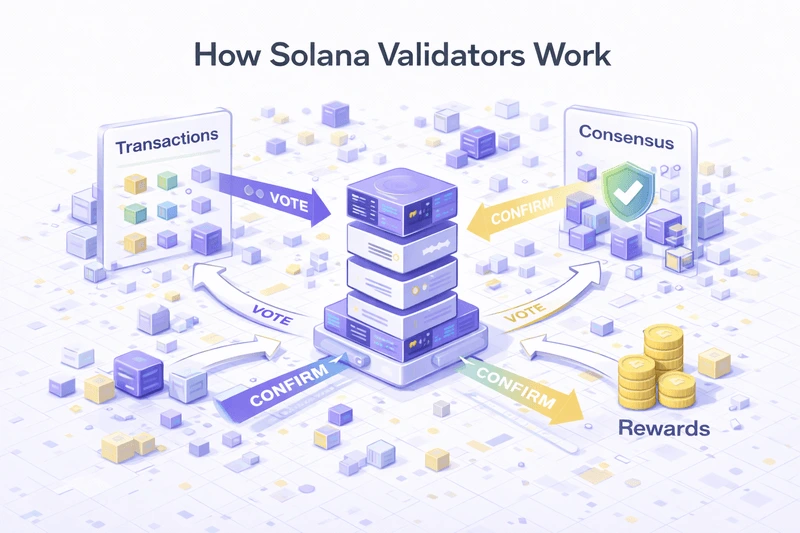
If you already know what a Solana validator is, the next question naturally follows: what do validators actually do behind the scenes? Validators are not passive servers. They are active participants in the network that constantly process transactions, produce blocks, and maintain consensus.
Every action you perform on Solana, including staking, swapping, or minting NFTs, depends on validators doing their job correctly. If you want a quick primer first, start here: What Is a Solana Validator.
The Role Validators Play in the Network
Solana is designed for speed, but speed alone means nothing without coordination. Validators provide that coordination by enforcing protocol rules and keeping the network synchronized.
Validators are responsible for:
- verifying transactions,
- producing and confirming blocks,
- maintaining network consensus,
- enforcing protocol rules.
They form a distributed system where no single entity controls the network, yet all participants agree on the same state of the blockchain. This balance between performance and decentralization is a key part of what makes Solana work.
How Solana Reaches Consensus
Solana uses a combination of Proof of Stake and Proof of History. Proof of Stake determines who participates in block production and how much influence they have. Proof of History provides a verifiable ordering of events through a cryptographic clock.
Together, these mechanisms reduce coordination overhead and help Solana stay fast while remaining decentralized. If you want to go deeper, see Proof of History Explained and How Solana Works.
How Block Production Works
Solana operates with a rotating leader schedule. At any given moment, one validator is selected as the leader. That leader receives transactions, orders them using Proof of History, produces blocks, and broadcasts them to the network.
Other validators verify those blocks and vote on their validity. Because the leader schedule is known in advance, Solana avoids delays from per-block leader elections and reduces overhead from competing block proposals. This design is one of the reasons Solana can process transactions quickly.
What Happens During an Epoch
Time on Solana is divided into epochs. An epoch is a fixed period during which the active validator set remains stable, staking weights are applied, and rewards accumulate.
At the end of each epoch, rewards are calculated, stake changes take effect, and a new leader schedule is created. This structure keeps the network predictable while still allowing it to adapt over time.
How Validators Earn Rewards
Validators earn rewards for performing their role correctly. These rewards generally come from network inflation and transaction fees. Validators take a small commission, and the rest is distributed to users who delegated their SOL to them.
This is why validator performance matters. Poor uptime or missed votes can reduce the rewards a validator earns and therefore the rewards delegators receive. For a deeper explanation of fees, see Validator Commission Explained.
Why Validator Performance Matters
Validators are continuously evaluated by the network. If a validator goes offline, misses votes, or performs unreliably, its rewards can decrease and delegators may move their stake elsewhere. This creates a natural incentive system where reliable operators attract long-term delegation.
You can view live validator performance and statistics here: 👉 Solana Validator Dashboard
Validators and Decentralization
Solana’s security depends on how evenly stake is distributed. If too much stake is concentrated on a small number of validators, decentralization suffers. If stake is spread across many independent operators, the network becomes stronger and more resilient.
By choosing validators carefully, users directly influence Solana’s decentralization.
Validator vs Node
Not all nodes are validators. A regular node can read data, relay transactions, and observe the network. A validator produces blocks, participates in consensus, and earns staking rewards. Only validators actively secure the network.
Why Validators Matter to Users
Even if you never run a validator yourself, validators affect your experience every day. Fast transactions, low fees, and network stability all depend on validators doing their job correctly.
When you stake SOL, you are not only earning rewards. You are also supporting the infrastructure that keeps Solana running.
Final Thoughts
Solana validators are the foundation of the network. They provide security, performance, decentralization, and reliable transaction processing.
Understanding how validators work gives you better context for how Solana achieves its speed and efficiency, and why staking plays such a central role in the ecosystem.
FAQ
What does a validator actually do on Solana?
Validators verify transactions, produce blocks when scheduled as leader, vote on block validity, and help the network agree on a single state.
Why do rewards vary between validators?
Rewards can differ because validator performance and reliability vary, and commission rates affect how rewards are shared.
Does validator downtime affect my staked SOL?
Downtime typically affects rewards rather than your staked principal. If a validator misses votes, rewards can be lower for that period.
👉 Next recommended articles: