Validator Risks and What Can Go Wrong
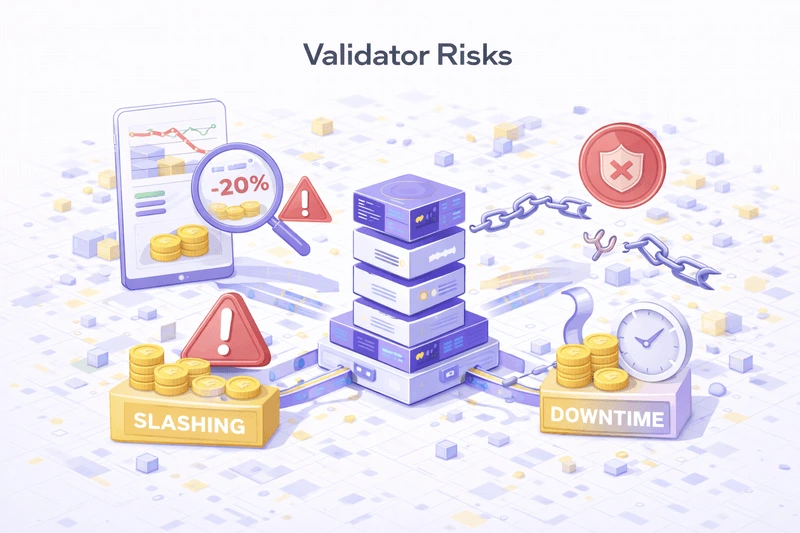
Staking is often described as one of the safer ways to earn yield in crypto, and in many ways that’s true. Still, it’s important to be honest from the start. Staking is not completely risk-free.
The good news is that most staking risks are predictable, easy to understand, and avoidable with basic knowledge. This article explains what can actually go wrong when staking with validators, without exaggeration or technical noise.
First, the Most Important Thing to Understand
Before talking about risks, it helps to clear up a common misunderstanding.
A validator can NOT steal your SOL.
When you stake:
- your tokens stay under your control,
- the validator never has custody of your funds,
- your rewards depend on validator performance.
This is a core design principle of Solana and one of the reasons staking is often considered relatively safe. If you’re new to this, it helps to start with How Staking Works.
Validator Downtime
The most common issue is simple downtime. If a validator goes offline, has unstable infrastructure, or misses votes, rewards can decrease for that period.
Nothing breaks and your funds are not usually lost. You simply earn less than expected. This is why validator reliability matters more than flashy numbers.
Lower Rewards Than Expected
Another common concern is when rewards look lower than expected. This can happen when more users join staking, the inflation schedule changes, validator performance is slightly lower, or network conditions shift.
Staking rewards are dynamic by design and fluctuate over time. To understand why this happens, see Solana Staking Rewards.
Validator Commission Changes
Validators can change their commission. Responsible validators usually do it rarely, communicate changes in advance, and avoid sudden spikes. Poorly managed validators may increase commission unexpectedly, which can reduce your rewards.
That’s why it helps to monitor your validator occasionally and avoid operators with an unstable history. Commission mechanics are explained in detail in Validator Commission Explained.
Centralization Risk
If too much stake accumulates on a small number of validators, the network becomes less decentralized. This may not affect individual users immediately, but it increases systemic risk over time.
Supporting reliable mid-sized validators can strengthen decentralization, improve network resilience, and reduce long-term risk. Choosing where you stake matters for the health of the network.
Risks of Liquid Staking
Liquid staking adds flexibility, but it can introduce extra layers of risk. These can include smart contract vulnerabilities, liquidity constraints when exiting, and protocol-level failures.
Well-established platforms can reduce these risks, but they cannot eliminate them completely. If you want a deeper explanation, see Liquid Staking on Solana.
What Happens If a Validator Disappears?
This is a common fear and one of the most misunderstood topics. If a validator shuts down, your SOL is typically not lost. Rewards may stop temporarily, and you can redelegate or unstake according to normal staking rules.
In most cases, the downside is lost time and missed rewards, not a loss of principal.
Slashing and Penalties on Solana
Different networks handle penalties differently. On Solana, common validator issues such as downtime generally show up as missed rewards rather than a direct reduction of a delegator’s staked principal.
The most practical takeaway is simple. Choose reliable validators, and treat staking rewards as performance-dependent.
The Real Risk Most People Ignore
The biggest risk often isn’t technical. It is staking without understanding what you’re doing.
Many issues happen when people expect instant withdrawals, chase unrealistic APY, don’t understand epochs, or panic during normal network behavior. Education removes most of the fear.
How to Reduce Risk in Practice
You don’t need advanced knowledge to stake more safely. A few habits go a long way:
- choose reliable validators,
- avoid extreme APY promises,
- check performance occasionally,
- don’t stake funds you may need urgently.
You can compare validator performance and reliability here:
Final Thoughts
Validator risks exist, but they are manageable and well understood. Staking on Solana is non-custodial, transparent, resilient, and beginner-friendly.
When done responsibly, staking remains one of the safer ways to participate in the Solana ecosystem.
FAQ
Can a validator take my SOL if I stake with them?
No. Delegation does not give the validator custody of your funds. Your SOL remains under your control, and the validator’s role is to earn rewards by participating in consensus.
What is the most common staking risk?
Validator underperformance. Downtime or missed votes can reduce rewards, which is why reliability matters.
How often should I check my validator?
Occasionally. A quick periodic check for performance and commission stability is usually enough for most stakers.
Is liquid staking riskier than native staking?
It can be, because it may add smart contract and liquidity considerations. The benefit is flexibility, but it comes with additional factors to evaluate.
👉 Next recommended articles: