Staking vs Holding
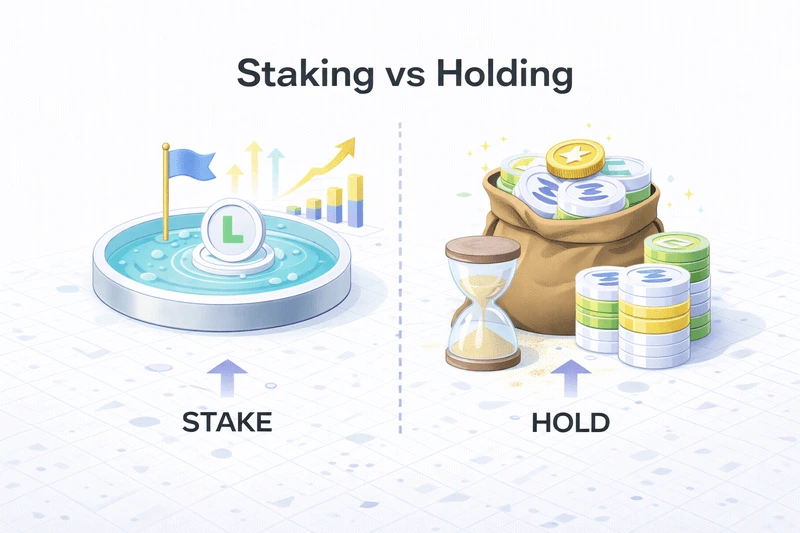
When people invest in crypto, they usually choose one of two approaches. They either hold their tokens and wait for price growth, or they stake them to earn additional rewards while supporting the network. Both strategies are widely used, but they serve different purposes. Understanding how they differ helps you choose the approach that fits your goals, your risk tolerance, and your time horizon.
If you’re new to staking, it helps to start with What Is Staking.
What Holding Means
Holding, often called HODLing, means keeping crypto in a wallet without using it. You don’t delegate it, lock it, or interact with protocols. You simply hold the asset and wait for its market value to change. This strategy is popular because it’s simple and keeps funds fully liquid, so you can move or sell at any moment.
Why People Choose Holding
Many users prefer holding because it offers maximum flexibility and minimal complexity. There are no lockups, no waiting periods, and no dependency on validators or smart contracts. This makes holding attractive for investors who believe in an asset long term but don’t want to engage with on-chain mechanics.
The main downside is that your assets remain idle. If the token you hold has staking, you might be giving up potential rewards during the time you hold.
What Staking Means
Staking is different. Instead of leaving tokens unused, you delegate them into a network’s staking system to support security and transaction validation. In return, you earn rewards over time.
On Solana, staking is a core part of how the network operates. Validators secure the chain through Proof of Stake, and delegators support validators by staking SOL. This process is explained step by step in How Staking Works.
How Staking Changes Your Position
When you stake SOL, your stake supports validators that produce blocks and maintain network integrity. In exchange, you earn rewards that accumulate over time and increase your total balance. This is why staking is often described as earning yield while still holding the asset.
The tradeoff is liquidity. With direct staking, your stake is not freely transferable, and unstaking typically takes time.
The Core Difference Between Staking and Holding
The difference comes down to what you want from your position.
Holding is fully liquid and simple, but it relies entirely on price appreciation. Staking can improve long-term returns through rewards, but it introduces network mechanics such as validator performance, reward variability, and unstaking delays.
Neither option is universally better. They serve different preferences and time horizons.
Where Liquid Staking Fits In
Liquid staking combines elements of both strategies. You stake SOL, but instead of giving up usability, you receive a liquid staking token that represents your staked position. That token can often be used in DeFi, traded, or exited more flexibly than direct staking.
If you want a deeper explanation, see Liquid Staking on Solana.
Risks to Consider
Both holding and staking involve risk, but the risks differ.
Holding mainly exposes you to market volatility.
Staking adds additional considerations, including validator performance and temporary lockups during unstaking. Liquid staking can add smart contract and liquidity risks on top of that. For a full risk overview, see Is Staking Safe?.
Which Strategy Is Right for You
There is no single correct answer. Holding can fit users who want simplicity and full liquidity. Staking can fit users who plan to hold long term and want additional yield. Liquid staking can fit users who want flexibility while still earning staking rewards.
Your choice depends on how actively you use crypto and how comfortable you are with on-chain mechanics.
Final Thoughts
Staking and holding are not competing strategies. They can complement each other. Holding reflects belief in an asset’s future value. Staking reflects participation in the network that supports that asset. Liquid staking can connect the two by keeping your position usable while it earns rewards.
For users who want to earn while staying flexible, platforms like JPool can make staking more practical.
FAQ
Is staking always better than holding?
Not always. Staking can improve long-term returns, but it adds lockups and relies on network mechanics and validator performance. Holding stays simpler and keeps full liquidity.
What is the biggest advantage of holding?
Liquidity and simplicity. You can move or sell at any time, and you do not rely on validators or protocol rules beyond basic wallet security.
What is the biggest advantage of staking?
You can earn additional tokens over time while still holding the asset, and you support network security through Proof of Stake.
How does liquid staking change the tradeoff?
Liquid staking can keep your position usable through a liquid token, but it can add smart contract and liquidity risks compared to direct staking.
👉 Next recommended articles: