Solana Accounts Model
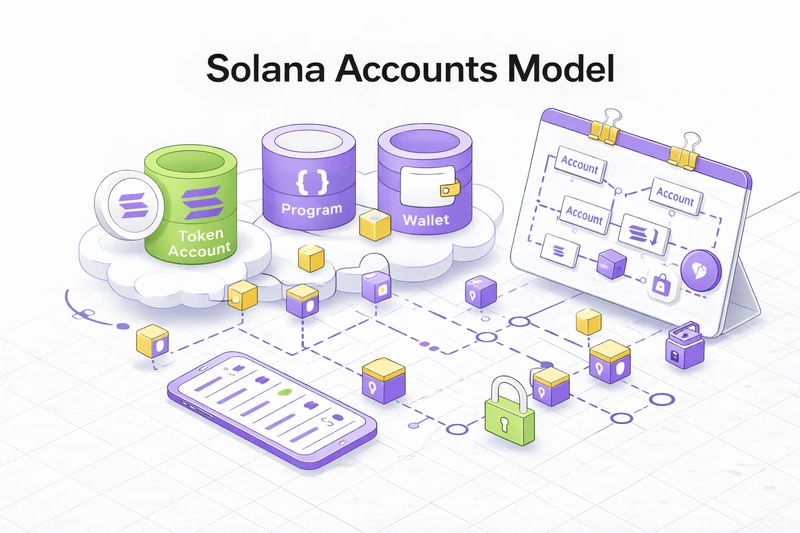
If you’ve ever tried to understand how Solana works under the hood, you’ve probably noticed something unusual very quickly: everything is an account.
This can confuse newcomers, especially if you are familiar with Ethereum. On Solana, programs do not store state the same way, data is often stored separately from code, and most interactions require explicitly listing which accounts a transaction will use.
At first, that can feel complicated. In practice, this design is one of the reasons Solana can process transactions quickly with low fees.
To understand Solana properly, it helps to start with How Solana Works, because the accounts model is tightly connected to Solana’s execution design.
What an Account Means on Solana
On Solana, an account is a container for data. That data can represent a wallet balance, token ownership, NFT metadata, staking information, or the internal state of an application.
Even programs are stored in accounts, but they play a different role. Regular accounts hold data. Program accounts contain executable code that can read or modify data accounts according to the rules of the program.
This separation between data and code is central to how Solana scales.
Programs and Accounts: Logic vs Data
A helpful way to think about Solana is that programs provide logic, and accounts provide storage.
Program accounts contain executable code, define which actions are allowed. They can be upgradeable if an upgrade authority exists, and can become immutable when that authority is removed.
Data accounts store balances, positions, and application state. They have an owner program and can only be modified by their owner program.
This strict separation keeps state changes explicit and predictable.
Why Solana Does Not Store State Inside Programs
On many smart contract platforms, a contract typically holds both logic and state. That makes development intuitive, but it can also create performance bottlenecks when many users interact with the same contract state.
Solana avoids that pattern by storing state in separate accounts. When a transaction runs, it tells the runtime exactly which accounts it will read and which accounts it will write.
That single requirement is what enables parallel execution and higher throughput.
For more on Solana’s performance design, see Why Solana Is Fast.
How This Enables Parallel Execution
Because a transaction declares its account access up front, Solana can decide whether it conflicts with other transactions.
If two transactions touch different accounts, Solana can execute them at the same time. If they touch the same writable account, the runtime schedules them safely so state updates remain correct.
This is a major reason Solana can handle heavy activity more efficiently than systems that rely on a single shared contract state.
This execution design also benefits DeFi, where many users interact with protocols constantly. If you want the DeFi context, see How DeFi Works.
Why Transactions Must Declare Accounts in Advance
One of the most important rules on Solana is that transactions must specify all accounts they will use before execution. This allows the runtime to detect conflicts in advance, schedule transactions safely, and maximize parallel execution.
It can feel restrictive if you are used to other models, but it is a key reason Solana can keep throughput high and fees low.
Account Ownership and Security
Every account has an owner program. Only the owning program can change that account’s data, and the protocol enforces this rule. This provides strong security guarantees. A transaction cannot modify data it does not have permission to modify, even if someone submits a malicious instruction.
It also makes behavior more predictable, which can help with auditing and reasoning about application logic.
Rent, Storage, and Account Lifetime
Solana has a rent model designed to discourage unlimited state growth. In practice, most accounts are created as rent-exempt by funding them with a minimum balance at creation time.
This approach makes account lifetime predictable for users and developers while keeping storage costs explicit.
Why Developers Prefer This Model
Solana’s accounts model can feel unfamiliar at first, but many developers prefer it once it clicks.
It makes data access explicit, reduces hidden state changes, and enables parallel execution by design. It also encourages applications to structure state in a way that scales under load.
Why Users Benefit From It
Even if you never write code, you benefit from the accounts model. It supports fast confirmations, low fees for many common actions, and responsive applications during periods of high activity.
Those user-facing benefits come from the same design choice: state access is explicit, and transactions that do not conflict can run in parallel.
This is part of what makes Solana staking and liquid staking apps feel smooth in real use, including JPool.
Final Thoughts
The Solana accounts model is one of the most important concepts in the ecosystem. By separating data from programs and enforcing explicit access rules, Solana enables parallel execution and high throughput at the base layer.
Once you understand this model, many parts of Solana, from DeFi to staking, become easier to understand.
FAQ
Why does Solana say “everything is an account”?
Because balances, token holdings, program code, and application state are all stored in accounts. Programs interpret and modify account data according to rules.
How is this different from Ethereum smart contracts?
On Ethereum, contracts often store their own state inside the contract. On Solana, programs are separate from the accounts that store state, and transactions must declare which accounts they will touch.
Why does declaring accounts help performance?
It lets the runtime see conflicts ahead of time. If transactions use different accounts, they can run in parallel instead of waiting in a single global queue.
👉 Next recommended articles: