How Validators Earn Rewards
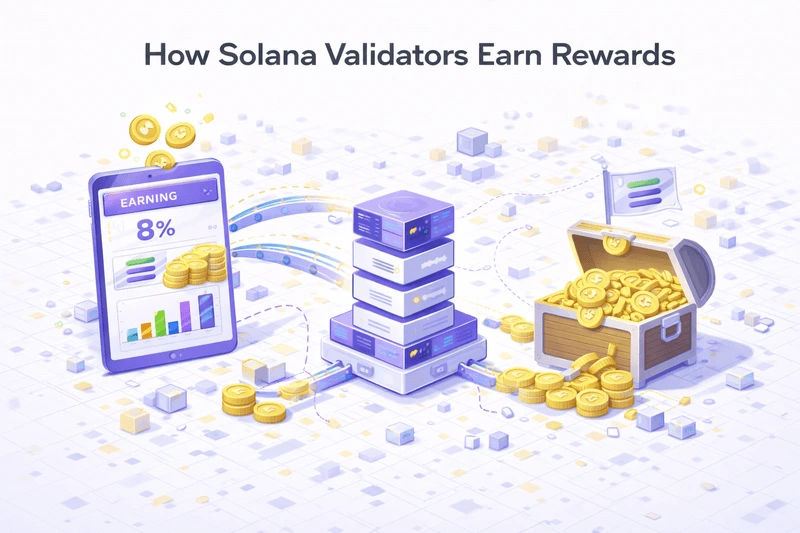
When people stake SOL, rewards don’t appear out of nowhere. They come from a system designed to keep the Solana network secure, decentralized, and efficient. Validators play a central role in this process, and understanding how they earn rewards makes it easier to understand where staking yield actually comes from.
This article explains the process in simple terms without technical complexity.
The Core Idea Behind Validator Rewards
At its foundation, Solana rewards validators for keeping the network running honestly and reliably. Validators operate the infrastructure that processes transactions, produces blocks, keeps the ledger in sync, and enforces network rules.
To ensure this work is done correctly, the protocol rewards validators economically. Those rewards are then shared with users who delegate their SOL.
Where Staking Rewards Come From
Validator rewards come primarily from network inflation. New SOL is issued according to Solana’s predefined schedule and distributed as staking rewards.
Transaction fees also exist, and validators can earn fees from network activity, but fees are usually a smaller component of staking returns than inflation.
Together, these sources make up the rewards distributed at the end of each epoch.
How Rewards Reach Delegators
The process is automatic and happens in the background. At the end of each epoch, the network calculates validator performance, rewards are assigned to validators, validators take their commission, and the remaining rewards are distributed to delegators.
If you are staking SOL, you don’t need to claim anything manually. Your rewards accrue over time. This mechanism is part of how staking works in general, which is explained in How Staking Works.
What Validator Commission Really Means
Validator commission is often misunderstood. It is not a fee taken from your wallet, and it does not reduce your staked amount. It is a percentage of rewards that the validator keeps for operating infrastructure.
For example, a validator with a 5% commission keeps 5% of the rewards generated and distributes the remaining 95% to delegators. This commission covers server infrastructure, uptime monitoring, maintenance and upgrades, and operational reliability. Without commission, running validators sustainably would be difficult.
Why the Lowest Commission Is Not Always Best
Many users assume that the lowest commission automatically means higher profits. In practice, that’s often not true. A validator with poor uptime or unreliable infrastructure may earn fewer rewards overall, even with a low commission.
Stable performance, consistent participation, and long-term reliability usually matter more than a small difference in commission percentage. That’s why many stakers use tools like the Solana Validator Dashboard to compare validator performance instead of focusing only on commission rates.
Why Rewards Can Vary Over Time
Staking rewards are not fixed. They change depending on total SOL staked, validator uptime, network load, and the inflation schedule.
Two users staking the same amount can receive slightly different rewards depending on when and where they stake. This variability is normal and expected.
To better understand how these factors affect your personal returns, you can use a staking reward calculator.
The JPool Validator Profit Calculator allows you to estimate potential rewards based on validator performance, commission, and stake amount — giving a more realistic view of expected yield before delegating.
Can Validators Lose Rewards?
Solana does not rely on aggressive slashing like some other networks, but validators can still lose rewards indirectly. If a validator goes offline, misses votes, or performs poorly, its rewards decrease and delegators earn less.
Over time, stake naturally flows toward better-performing validators, which strengthens the network.
Why This System Works
Solana’s reward model aligns incentives across the network. Validators are motivated to stay online, maintain performance, and act honestly. Delegators are motivated to choose reliable validators, support decentralization, and stake long term.
As a result, the network benefits from strong security, predictable operation, and sustainable growth.
Final Thoughts
Validator rewards are not a bonus or a marketing incentive. They are the economic engine that keeps Solana running.
When you stake SOL through platforms like JPool, you are earning yield and supporting the infrastructure that makes the network possible. Understanding how validators earn rewards gives you a clearer picture of how staking works and why it remains one of the most stable ways to participate in Solana.
FAQ
Where does SOL staking yield come from?
Staking yield generally comes from protocol issuance through inflation and a portion of transaction fees that are distributed as rewards.
Does validator commission reduce my staked SOL?
No. Commission is taken from rewards, not from your staked principal.
Why can two validators with the same commission pay different rewards?
Performance matters. Differences in uptime and voting consistency can change how many rewards a validator earns and shares.
Do I need to claim rewards manually?
Usually no. Rewards typically accrue automatically as part of the staking mechanism.
👉 Next recommended articles: