Why Validator Choice Matters
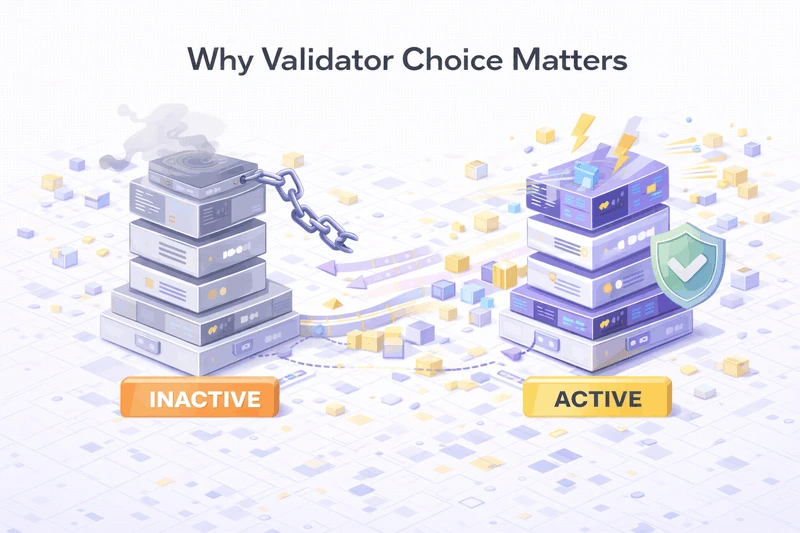
When people start staking SOL, the process often looks simple. You pick a validator, delegate your tokens, and wait for rewards to arrive. Technically, that’s correct.
What many users don’t realize is that the validator you choose influences what happens next. It affects how consistent your rewards are and it also affects how healthy the Solana network remains over time.
This article explains why validator choice matters, even when everything looks identical at first glance.
At First, All Validators Look the Same
When you open a list of validators for the first time, the differences can look minimal. Many validators show similar commission, similar stake size, and similar uptime numbers.
Because of this, many users choose the first validator in the list or the one with the lowest commission. That approach works, but it is rarely the best decision.
Staking Is More Than Just Numbers
When you stake SOL, you are delegating stake to a specific validator. That validator represents you in the consensus process.
In practice, this means the validator earns rewards on your behalf, your rewards depend on its performance, and your stake contributes to the validator’s influence. Choosing a validator is not like picking a savings account. It is closer to choosing a long-term operator to represent your stake.
Why Validator Choice Affects Your Rewards
Two validators can show the same commission rate and still produce different results. Rewards depend on uptime consistency, voting participation, infrastructure stability, and long-term reliability.
A validator that goes offline occasionally will generally earn fewer rewards over time, and that can reduce the rewards shared with delegators. This is why focusing only on commission can lead to worse outcomes.
Validator Choice Affects the Network Itself
Validator choice also affects Solana’s decentralization. The network’s resilience depends on how stake is distributed.
If too much SOL accumulates on a small number of validators, risks become concentrated and decentralization weakens. When users spread stake across multiple reliable validators, the network becomes healthier and more secure. Individual choices add up over time and help shape Solana’s long-term security profile.
The Most Common Mistake
The most common mistake is not choosing the “wrong” validator. It is never checking again.
Validators can change commission rates, infrastructure quality, and operational behavior. A validator that performed well six months ago may not be the best choice today. Reviewing your validator occasionally is a simple habit that can protect your staking results.
How to Choose Without Overthinking
You don’t need deep technical knowledge to make a good decision. A strong validator usually operates consistently, keeps reasonable commission, communicates transparently, shows stable performance history, and avoids sudden changes.
To compare validators using real performance data, you can use:
This gives you an objective view instead of relying on surface-level numbers.
Why This Matters in the Long Run
Staking is often described as passive income, but it is also participation in network security. Your validator choice influences your long-term rewards, network stability, decentralization, and overall trust in the ecosystem.
Small decisions, multiplied by thousands of users, shape the future of Solana.
Final Thoughts
Choosing a validator is not about chasing the highest percentage. It is about choosing reliability, consistency, and long-term thinking.
When you choose well, staking becomes what it is meant to be: a straightforward way to participate in Solana while keeping risk manageable.
FAQ
Does my validator choice really affect rewards?
Yes. Performance varies between validators. Differences in uptime and voting consistency can change how many rewards a validator earns and shares.
Is the lowest commission always best?
Not always. A low commission does not help if the validator underperforms. Reliability can matter more than a small commission difference.
How often should I review my validator?
Occasionally. A periodic check for performance and commission stability is usually enough for most stakers.
👉 Next recommended articles: