Understanding Redemption Liquidity in Liquid Staking Pools
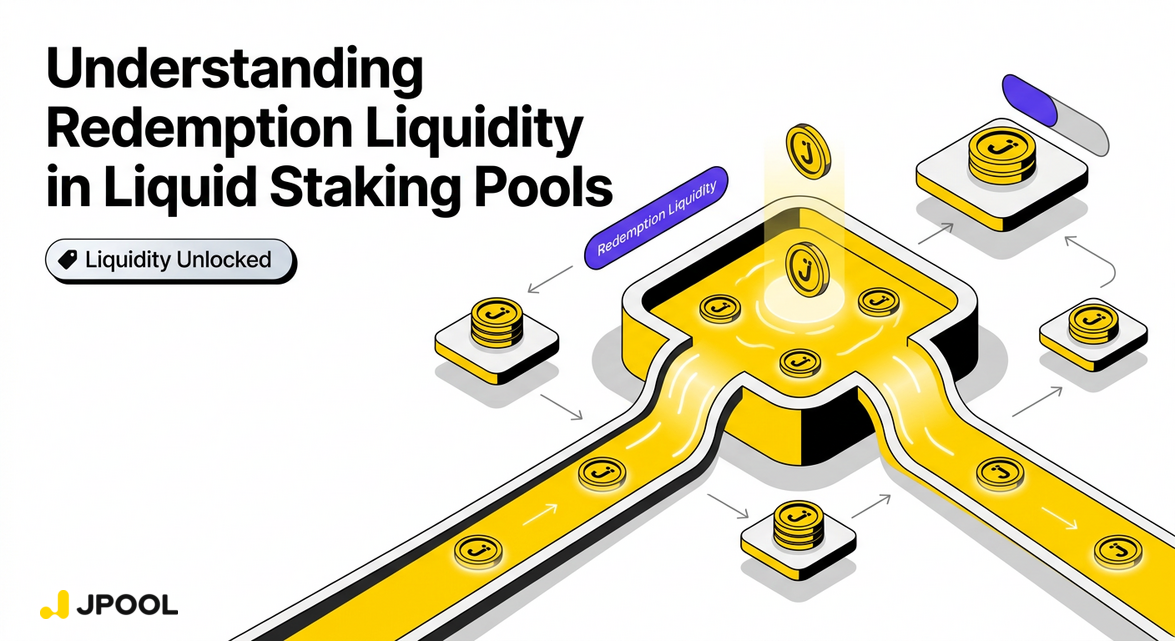
Most guides about Solana liquid staking focus on entry: how to stake, which validators are selected, and what APY to expect. Far fewer address the mechanics that matter most when you actually need your SOL back. Redemption liquidity — the ability to exit a staked position efficiently, at the right cost, and without surprises — is where the structural maturity of a liquid staking platform is truly tested.
Table of Contents
- The Three Exit Routes: Not All Redemptions Are Equal
- The Reserve Buffer: JPool’s Structural Liquidity Backstop
- The DeFi-Lock Blind Spot: When Your JSOL Isn’t Fully Redeemable
- Leveraged Positions: The Most Complex Exit Sequence
- Choosing Your Exit Route: A Decision Framework
- Why Redemption Liquidity Is the Real Measure of Platform Maturity
This guide maps every JSOL exit route in precise detail, surfaces the tradeoffs most users never consider until it’s too late, and gives you a decision framework to choose the right path for your situation.
The Three Exit Routes: Not All Redemptions Are Equal
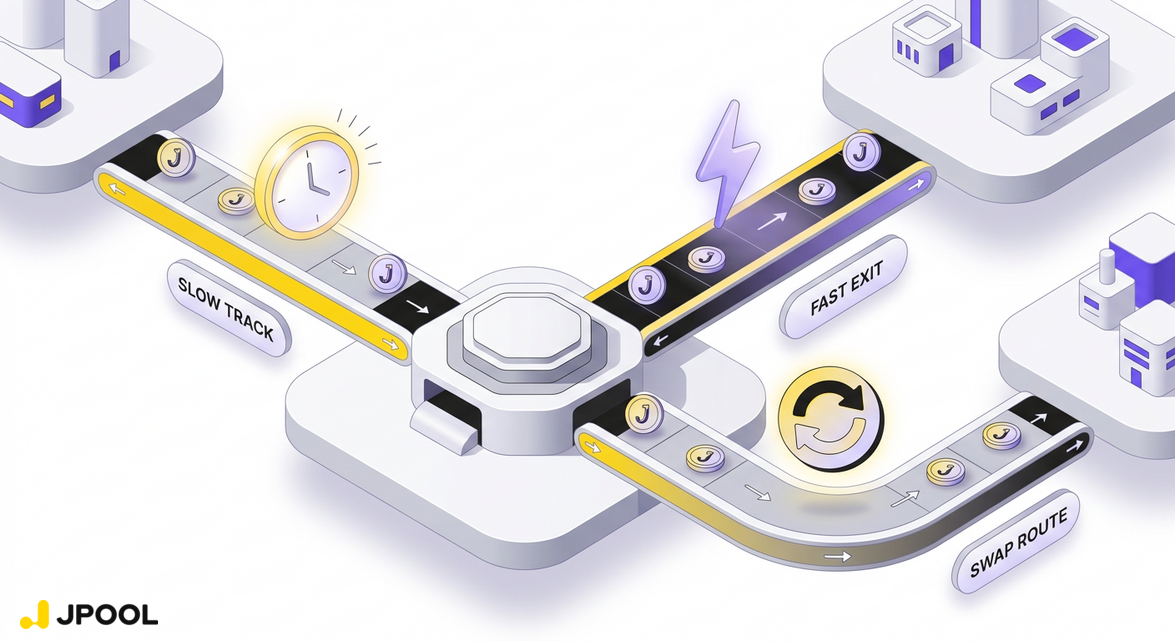
When you hold JSOL and want to convert back to SOL, JPool offers three structurally distinct paths. Understanding the mechanics of each is the foundation of any solana liquid staking redemption liquidity strategy.
Route 1: Delayed Unstake (Protocol-Native, Lower Fee)
The delayed unstake route redeems JSOL directly through the JPool stake pool at the end of the current Solana epoch. The SOL you receive equals your JSOL balance multiplied by the current exchange rate, minus applicable fees. Because the pool processes this redemption at epoch boundary — when validator stake accounts are settled — no liquidity premium is charged beyond a standard, lower fee.
The tradeoff is timing. Your wait depends entirely on where you are in the current epoch cycle: submit near the end of an epoch and SOL arrives quickly; submit at the start and you wait through the remainder of that epoch.
Best for: Users who are not time-sensitive and want to minimize exit costs.
Route 2: Instant Unstake (Protocol-Native, Higher Fee)
Instant unstake allows you to receive SOL immediately by paying a higher fee. Critically, the JPool documentation explicitly states that availability “depends on pool liquidity and may involve price impact/slippage.” This is the detail most users overlook: instant unstake is not unconditionally available. It draws from the pool’s liquid reserves, and under high redemption pressure, the price impact can be meaningful.
The SOL received still equals your JSOL balance multiplied by the current exchange rate — minus the higher fee and any applicable price impact. This route is not a free shortcut; it is a liquidity premium you pay to bypass the epoch wait.
Best for: Users with urgent liquidity needs who accept a higher cost and understand availability is conditional.
Route 3: DEX Swap (Secondary Market, Immediate)
JSOL is a standard SPL token, which means it can be swapped directly on Solana DEXes for SOL without interacting with the JPool protocol at all. This route is genuinely immediate and does not depend on pool liquidity reserves. However, it introduces a different cost variable: DEX slippage, which is determined by the depth of JSOL/SOL liquidity pools on secondary markets rather than by JPool’s protocol mechanics.
Best for: Users who need the fastest possible exit and are willing to accept market-determined slippage rather than protocol-determined fees.
The Reserve Buffer: JPool’s Structural Liquidity Backstop
A detail that receives almost no attention in liquid staking discussions is how a pool manages large, sudden withdrawal requests without destabilizing validator delegations.
JPool maintains a reserve account holding 1% of total staked SOL. This reserve exists specifically to fulfill large withdrawal requests without requiring immediate unstaking from validators. If a withdrawal reduces the reserve below the 1% threshold, JPool replenishes it by proportionally reducing the stake of all participating validators. Conversely, large incoming deposits are distributed among eligible validators during the current epoch.
This mechanism has a direct implication for redemption liquidity: the reserve acts as a first-line buffer that absorbs redemption pressure before it cascades into validator-level stake changes. For users making large redemptions, this means the pool’s structural design — not just its fee schedule — determines how smoothly your exit executes.
The DeFi-Lock Blind Spot: When Your JSOL Isn’t Fully Redeemable

Here is the hidden cost that catches the most users off guard.
JSOL’s composability — the ability to use it as collateral in lending protocols, provide it to liquidity pools, or deploy it in other DeFi applications — is one of its core strengths. But composability creates a liquidity split that is invisible unless you know where to look.
When you check your unstakable amount in JPool’s Direct Staking interface, the platform explicitly shows how many JSOL you can currently exchange back for SOL. If this amount is lower than your total stake balance, it means part of your JSOL tokens are locked in DeFi protocol(s). Those tokens are not redeemable through the protocol until they are withdrawn from the external application holding them.
This is not a flaw — it is the expected behavior of a composable token. But it means that a user who has deployed JSOL as collateral in a lending protocol and simultaneously wants to unstake faces a two-step process: first, withdraw or deleverage from the DeFi position; second, proceed with the standard unstake flow. Treating these as a single step is the most common redemption planning error in liquid staking.
Leveraged Positions: The Most Complex Exit Sequence
For users in a leveraged staking position, the redemption path is structurally different from standard unstaking and deserves its own analysis. Understanding yield mechanics like MEV and validator revenue is foundational context — covered in depth in The Complete Guide to Solana Staking Yield Mechanics — but the exit sequence for leveraged positions introduces an entirely separate layer of complexity.
When you deleverage, JPool executes an atomic flash-loan sequence within a single transaction:
- JPool takes a flash loan of SOL equal to your current debt on the lending platform.
- The flash-loan SOL fully repays your outstanding borrowed amount, freeing the locked JSOL collateral.
- JPool unstakes just enough JSOL to obtain the SOL required to repay the flash loan — only the portion needed.
- Any remaining JSOL is returned to your wallet in its de-multiplied form.
You can deleverage completely or partially. In a partial deleverage, the same sequence executes proportionally, improving your Loan-to-Value (LTV) ratio and Health Factor without fully closing the position.
The redemption liquidity implication here is significant: a leveraged position cannot be exited through a simple “unstake” click. The JSOL is locked as collateral on a third-party lending platform. Your effective redemption liquidity is gated by the deleverage transaction, which itself depends on flash loan availability and the lending platform’s conditions. Users who build leveraged positions should factor this multi-step exit cost into their position planning from the outset.
Choosing Your Exit Route: A Decision Framework
Understanding how redemption liquidity works in Solana liquid staking pools is only half the equation — knowing which path to take for your specific situation is the other half. Given the three exit routes and the two structural constraints (reserve buffer availability, DeFi-lock status), here is a practical decision framework for JSOL redemption:
- Step 1 — Check your unstakable amount: Before initiating any exit, confirm how much JSOL is freely redeemable versus locked in DeFi protocols. If a portion is locked, address that position first.
- Step 2 — Assess your time horizon: If you can wait until the end of the current epoch, the delayed unstake route delivers the lowest exit cost with full protocol-native settlement. If timing is critical, move to Step 3.
- Step 3 — Evaluate instant unstake availability and cost: Instant unstake is available subject to pool liquidity. Check the current fee and any indicated price impact before confirming. If the cost is prohibitive or availability is constrained, consider the DEX route.
- Step 4 — Compare DEX slippage against instant unstake cost: For smaller positions, DEX slippage on a well-capitalized JSOL/SOL pool may be lower than the instant unstake fee. For larger positions, the inverse may be true. The optimal route depends on position size and current market depth — neither is universally superior.
- Step 5 — For leveraged positions, deleverage first: Execute the deleverage transaction to release JSOL collateral before attempting any standard unstake. Partial deleverage is available if you only need to free a portion of your position.
Why Redemption Liquidity Is the Real Measure of Platform Maturity
Entry into a liquid staking position is trivially easy on any platform. The structural test is exit: how many routes exist, how transparent are the costs, and what happens when redemption pressure is high?
When evaluating the best Solana liquid staking platform for liquidity, the answer lies not in headline APY but in architectural depth. JPool’s architecture addresses this through three complementary mechanisms: a dual-path protocol redemption system (instant and delayed), a 1% reserve buffer that absorbs large withdrawal requests before they impact validator delegations, and secondary market liquidity through JSOL’s DEX composability. For users in leveraged positions, an atomic flash-loan deleverage sequence provides a structured exit path that does not require manual debt management.
Understanding these mechanics before you need them is not optional — it is the difference between an efficient exit and an expensive one.
Explore JPool’s liquid staking strategies at jpool.one.