How Delegation Concentration Affects Solana’s Nakamoto Coefficient
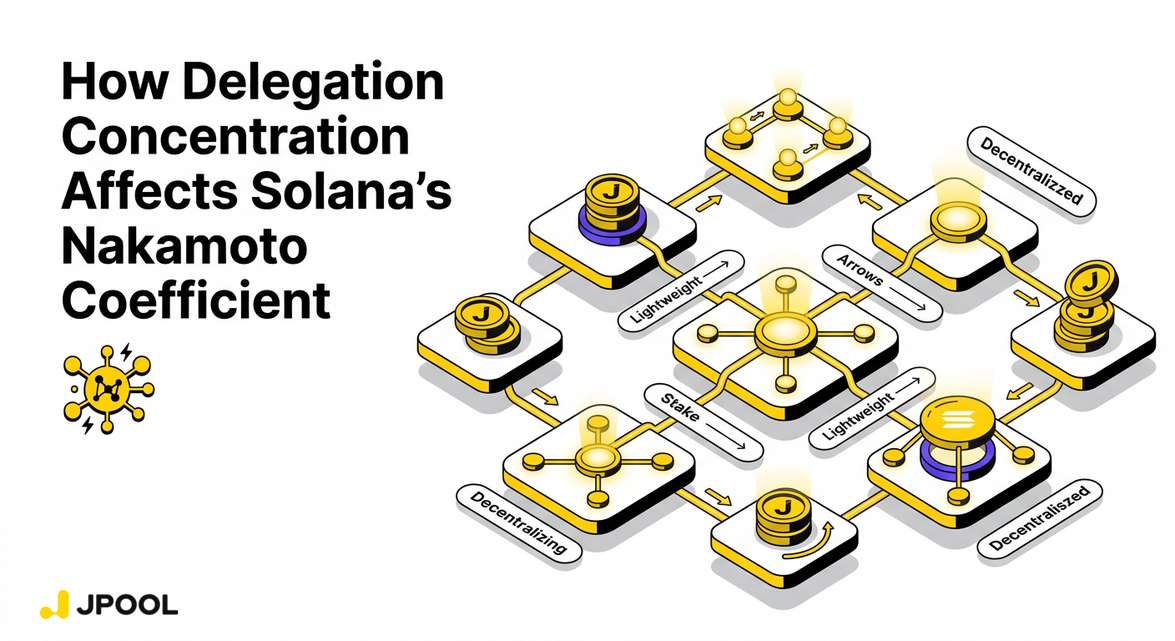
The Nakamoto Coefficient is the minimum number of independent validators that would need to collude to halt or corrupt a blockchain network. On Solana, where Proof-of-Stake means voting power is proportional to delegated stake, this number is directly shaped by how stake is distributed—not just across validators, but across the infrastructure they run on. When stake clusters, the Nakamoto Coefficient compresses. When it disperses, the network becomes structurally harder to attack or censor.
Table of Contents
- The Structural Problem: Why Stake Gravitates Toward Concentration
- How Concentration Scores Function as a Decentralization Forcing Function
- The Scoring Weight Asymmetry: What the Numbers Reveal
- Liquid Staking’s Dual Role: Amplifier or Corrective?
- The Compounding Effect: Community Good and the Ecosystem Multiplier
- Conclusion: Delegation Design Is Network Design
Most conversations about Solana validator decentralization stop at the validator count. This analysis goes deeper into the specific scoring mechanics that determine whether liquid staking delegation actively improves or silently erodes the Nakamoto Coefficient over time.
The Structural Problem: Why Stake Gravitates Toward Concentration
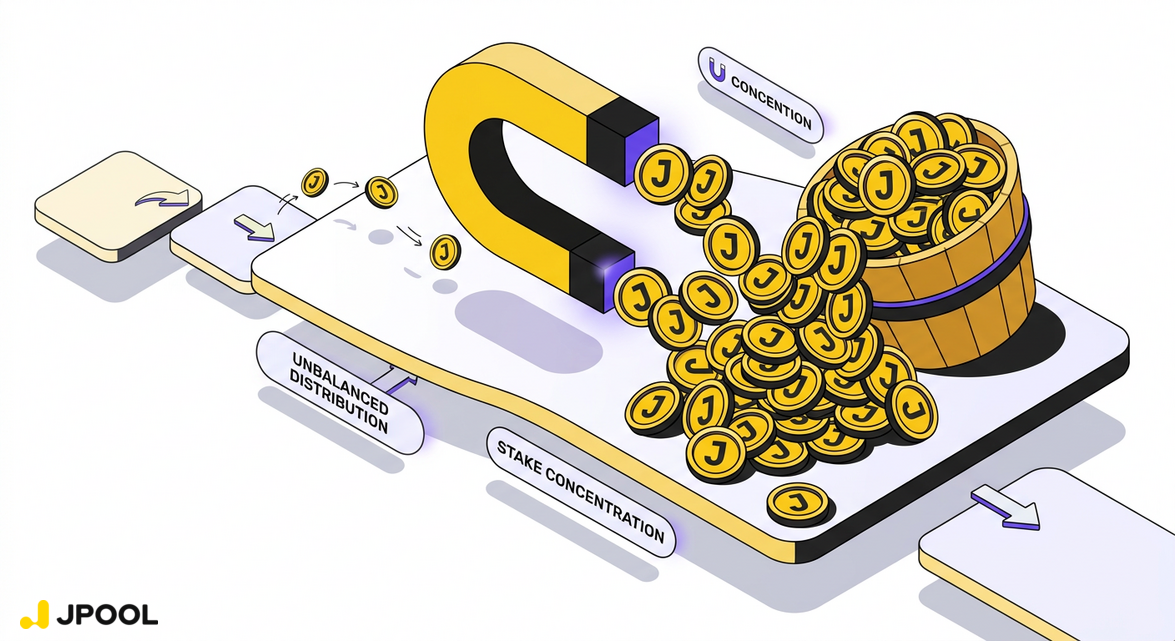
Stake concentration is not the result of malicious intent—it is the predictable output of rational delegation behavior. Delegators optimizing purely for yield will naturally flow toward the highest-performing validators. High-performing validators, in turn, attract more stake, which can compound their influence over consensus. Left unchecked, this feedback loop produces a superminority: a small group of validators controlling enough stake to influence network outcomes.
JPool’s inclusion criteria explicitly exclude any validator that is a member of the Superminority group. This is a hard gate, not a soft preference; a validator cannot participate in JPool’s delegation program at all if it already holds disproportionate consensus power. JPool also enforces a maximum stake cap of 750,000 SOL per validator, ensuring that even high-performing nodes cannot accumulate stake beyond a threshold that would dangerously concentrate voting weight.
These are structural constraints. However, the more revealing mechanism is what happens inside the scoring system—where decentralization pressure is embedded directly into yield-weighted delegation.
How Concentration Scores Function as a Decentralization Forcing Function
JPool’s validator scoring system evaluates each validator across nine metrics, producing a total adjusted score between 3 and 39. Four of those nine metrics are dedicated exclusively to infrastructure diversity, measuring stake concentration across independent dimensions of the validator’s hosting environment.
Each of these four concentration metrics is scored on a scale of 1 to 10, with a weight of 0.25 each. Critically, the scoring is relative: all possible concentration values across all validators are aggregated into 10 equal bands, and each validator is placed within that distribution. This means the score is not a static threshold; it is a continuously recalibrated ranking that responds to the actual state of stake distribution across the network at any given moment.
The practical implication is significant. A validator hosted in an environment where cumulative stake has grown—even if that validator’s own stake has not changed—will receive a lower concentration score. The scoring system treats ecosystem-level concentration as the relevant variable, not just the individual node’s footprint. As JPool’s documentation states: “The more stake a group of validators in a single [hosting environment] attracts from delegators, the higher the concentration of stake… High rates of stake concentration are bad for Solana’s health because they bring down the network’s decentralization, which can create a point of failure.”
This is a fundamentally different design philosophy from yield-only delegation. It means that two validators with identical APY performance can receive meaningfully different delegation weights based solely on where their infrastructure sits in the broader stake distribution.
The Scoring Weight Asymmetry: What the Numbers Reveal
Examining the full scoring table reveals a deliberate architectural choice. The four infrastructure diversity metrics together contribute a maximum of 10 adjusted-weight points (4 × 0.25 × 10). The three APY metrics together contribute a maximum of approximately 9.9 adjusted-weight points (3 × 0.33 × 10). In other words, infrastructure diversity and yield performance carry near-equal total weight in determining a validator’s score-based delegation.
This parity is not accidental. It encodes a specific institutional stance: a validator’s contribution to network decentralization is as valuable as its contribution to staker yield. For delegators who assume liquid staking protocols simply chase the highest APY, this scoring architecture reveals a more complex reality.
The Validators.app score (weight: 1, max: 11) and the Smart Validator Toolkit (SVT) bonus (weight: 4, max: 2 points) round out the system. SVT—JPool’s free validator management tool—rewards operators who adopt standardized, auditable node management practices:
- A validator running SVT receives 2 points.
- A validator running sv-manager receives 1 point.
- Unmanaged nodes receive 0 points.
This creates an incentive layer that correlates operational professionalism with delegation access, further filtering for validators that are less likely to become points of failure.
Liquid Staking’s Dual Role: Amplifier or Corrective?
Liquid staking protocols occupy a structurally powerful position in the Solana validator ecosystem. Because they aggregate retail delegation at scale, their internal allocation logic has outsized influence on where stake flows across the network. A protocol that delegates purely based on yield will amplify existing concentration. Conversely, a protocol that weights infrastructure diversity will act as a corrective force.
JPool’s liquid staking delegation strategy is designed to function as the latter through several key mechanisms:
- The Superminority exclusion removes already-concentrated validators from consideration entirely.
- The 750,000 SOL cap prevents any single validator from accumulating excessive stake through the pool.
- The concentration scoring system continuously redirects score-based delegation away from infrastructure environments where stake is already clustering—even as the pool grows.
This architecture means that as JPool’s total staked SOL increases, the decentralization pressure it exerts on the network scales proportionally. More pooled SOL distributed through a concentration-aware scoring system means more stake actively flowing toward underrepresented infrastructure environments. The Nakamoto Coefficient, in this framing, is not just a network-level metric; it is a direct output of how delegation protocols are designed.
For a deeper look at how validator selection and delegation mechanics interact with staking yield, see The Complete Guide to Solana Staking Yield Mechanics: MEV, Priority Fees, and Validator Revenue.
The Compounding Effect: Community Good and the Ecosystem Multiplier

One dimension of JPool’s liquid staking delegation strategy that receives little attention in standard decentralization discussions is the Community Good framework. Validators whose earnings fund projects that introduce new functionality to the Solana ecosystem—across tracks including developer tooling, liquidity, and user acquisition—receive additional bonus stake.
The Community Good score ranges from 1 to 14, and the resulting bonus stake is calculated by multiplying that score by 3,000 SOL. This means a maximum-scoring validator can receive up to 42,000 SOL in additional delegation. This is not a trivial amount for an independent validator. It creates a material economic incentive for smaller, ecosystem-contributing operators to remain viable—precisely the category of validator most at risk of being crowded out by stake concentration dynamics.
The mechanism matters for the Nakamoto Coefficient because it actively subsidizes the long-tail of the validator set. Validators that contribute to ecosystem growth but may not yet command top-tier APY performance can remain economically sustainable through Community Good delegation. This expands the effective validator set that holds meaningful stake, which is the foundational requirement for a higher Nakamoto Coefficient.
Conclusion: Delegation Design Is Network Design
The Solana Nakamoto Coefficient is not a fixed property of the network; it is a dynamic output of how stake is allocated, epoch by epoch, across thousands of validators. Liquid staking protocols that manage significant pooled stake are, whether they acknowledge it or not, making active choices about network topology with every delegation cycle.
JPool’s Smart Delegation Strategy encodes decentralization as a first-class objective—not through marketing language, but through concrete scoring mechanics. It implements this by:
- Placing infrastructure diversity on equal footing with yield performance.
- Hard-excluding Superminority validators.
- Capping individual validator stake at 750,000 SOL.
- Creating economic incentives for ecosystem-contributing operators to remain viable.
Each of these mechanisms applies pressure against the concentration dynamics that compress the Nakamoto Coefficient.
For delegators, the implication is clear: choosing a liquid staking delegation strategy is not just a yield decision. It is a vote on what kind of network Solana becomes.